

The short version
- Every guide we read uses the same order: who is hosting, the request, your names, the date and time, the venue with its city, then what follows, such as "Reception to follow".
- Whoever hosts goes on the top line: traditionally the bride's parents; when both families or the couple host, "Together with their families" or your own names open it. Use "the honour of your presence" for a ceremony in a house of worship and "the pleasure of your company" anywhere else.
- Check the weekday before you print: on the wording guides we read, 28 of 41 example dates name a day the date doesn't fall on. WedGenie's free invitation maker now flags that as you type.
Wedding invitation wording follows one order everywhere: who is hosting, the request ("request the pleasure of your company"), your names, the date and time, the venue with its city, and then what follows ("Reception to follow"). What changes is the top line, which names whoever is hosting, and how formal the language is.
Below, one fictional wedding is worded every way it could be hosted. Nadia and Owen (the couple from our speech examples) marry on Saturday, June 12, 2027; two other made-up families cover divorced parents, a late parent and two mothers. Every example was typed into WedGenie's free invitation maker, so you can copy the lines and see them set on a card.
One more thing before you print: check the weekday. On the wording guides we read, 28 of 41 example dates named the wrong day.
What goes on a wedding invitation, line by line
Six lines, in a fixed order. WeddingWire puts it as "1. Name the hosts. 2. Make a request... 3. Say it's a wedding. 4. State the guests of honors' names. 5. Include date and time information. 6. Share the venue. 7. Add additional reception information... 8. Attire instructions are optional." Minted's version: "The traditional structure of host line, request line, names, and details works for everyone."
| Line | Formal | Casual |
|---|---|---|
| Who is hosting | Mr. and Mrs. Paul Andrew Moreno | Together with their families, or nothing |
| The request | request the pleasure of your company / at the marriage of their daughter | invite you to celebrate their wedding |
| Your names | Nadia Leigh / to / Mr. Owen James Hartley | Nadia & Owen |
| Date and time | Saturday, the twelfth of June / two thousand twenty-seven / at half after four o'clock | Saturday, June 12, 2027 · 4:30 p.m. |
| Venue | Larkspur Hall / Austin, Texas | Larkspur Hall · Austin, Texas |
| What follows | Reception to follow | Dinner and dancing to follow |
The Knot allows one modern change: "Put your names front and center at the top."
Who goes on the host line
Whoever is hosting, traditionally the bride's parents. Minted: "Traditionally, the bride's parents host, and so their names come first. But no matter who's paying for the wedding, listing the names of both sets of parents is acceptable (and gracious)." The Knot ties the line to money: "it's respectful to list anyone contributing financially to your wedding on your invites, either by name or in the form of a short line, like "together with their families."" (Who usually pays, and how to ask, is in who pays for the wedding.)
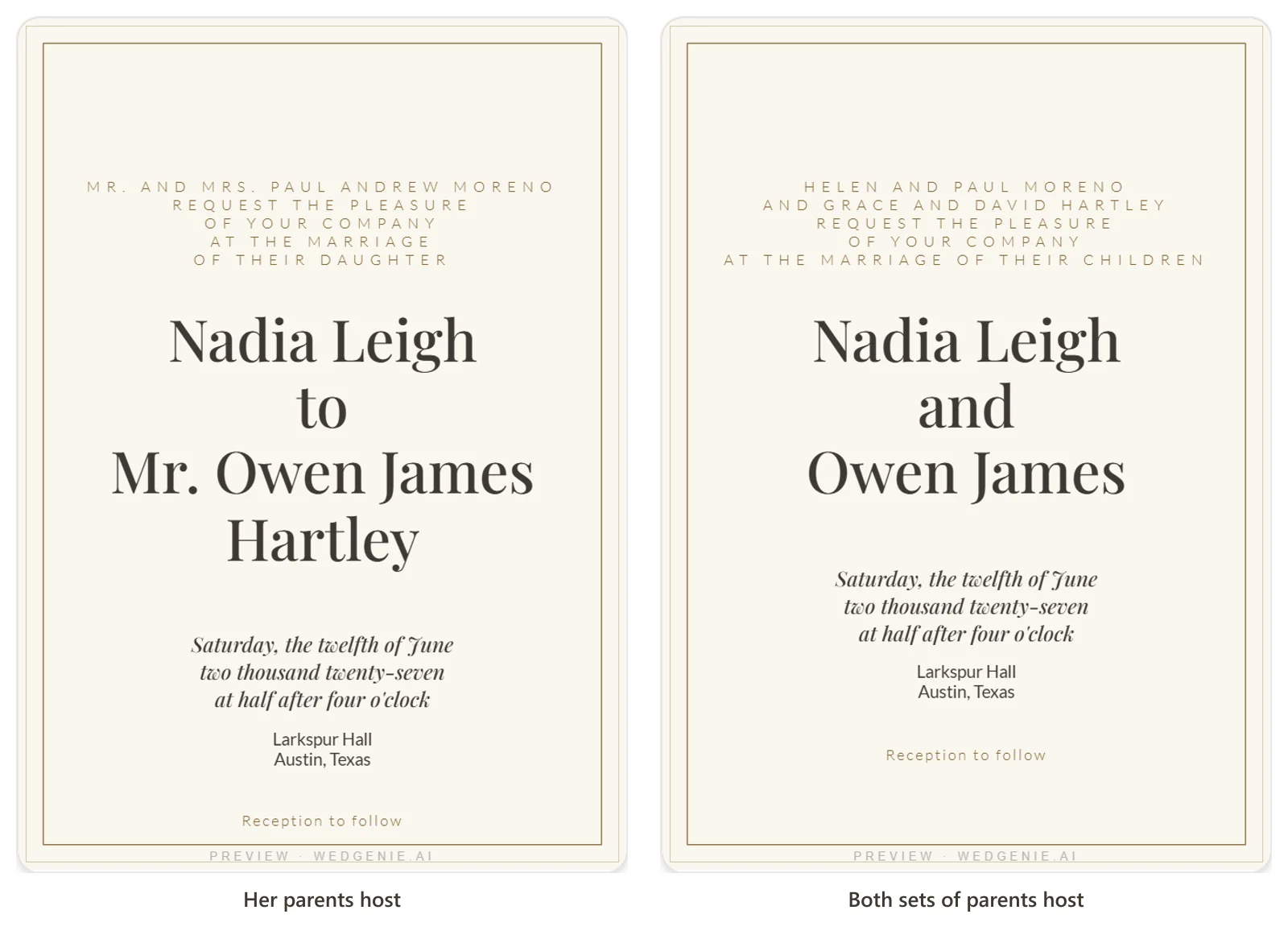
Her parents host
Mr. and Mrs. Paul Andrew Moreno
request the pleasure
of your company
at the marriage
of their daughter
Nadia Leigh
to
Mr. Owen James Hartley
Saturday, the twelfth of June
two thousand twenty-seven
at half after four o'clock
Larkspur Hall
Austin, Texas
Reception to follow
Classic Serif template. Each line break above is an Enter in the maker.
Emily Post's rules for this card: "If the bride shares her parents' last name, only her first and middle name are used," and "The groom's name is spelled out, and is preceded by a title."
Both sets of parents host
Helen and Paul Moreno
and Grace and David Hartley
request the pleasure
of your company
at the marriage of their children
Nadia Leigh
and
Owen James
Saturday, the twelfth of June
two thousand twenty-seven
at half after four o'clock
Larkspur Hall
Austin, Texas
Reception to follow
Classic Serif template. Each line break above is an Enter in the maker.
Minted: "For different-sex couples, list the bride's parents' names at the top of the invite, then the groom's parents' names. For same-sex couples, list the names according to preference or in the order that looks best."
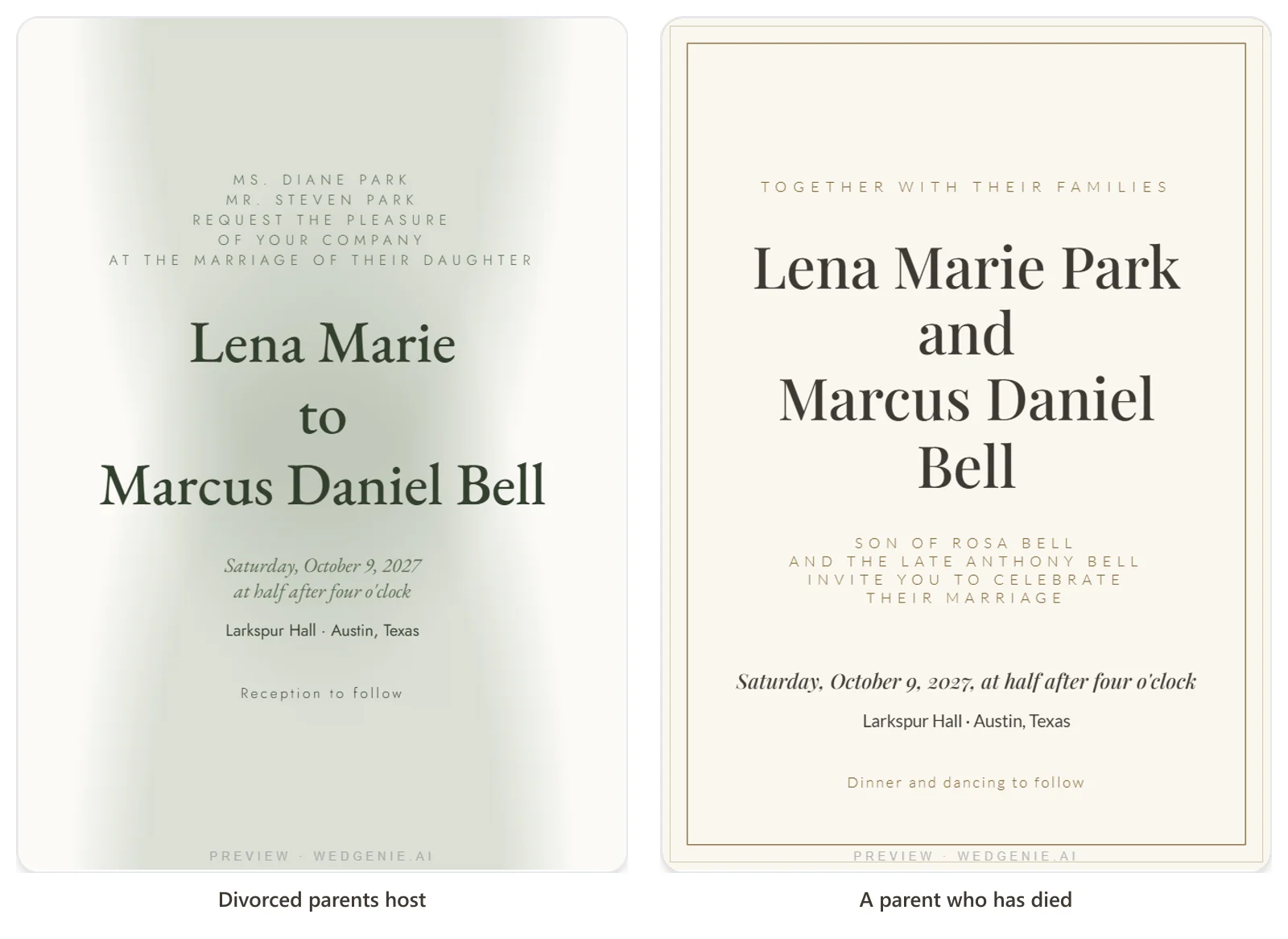
Divorced parents
Ms. Diane Park
Mr. Steven Park
request the pleasure
of your company
at the marriage of their daughter
Lena Marie
to
Marcus Daniel Bell
Saturday, October 9, 2027
at half after four o'clock
Larkspur Hall · Austin, Texas
Reception to follow
Botanical template. Each line break above is an Enter in the maker.
Minted: "Include the mother's name first, followed by the father's name. Do not use "and" to connect the two names; rather, each name should get its own separate line." Stepparents "may be listed on the same line as the parent to whom they are married" (WeddingWire).
A parent who has died
Together with their families
Lena Marie Park
and
Marcus Daniel Bell
son of Rosa Bell
and the late Anthony Bell
invite you to celebrate
their marriage
Saturday, October 9, 2027, at half after four o'clock
Larkspur Hall · Austin, Texas
Dinner and dancing to follow
Classic Serif template. Each line break above is an Enter in the maker.
"It's not required to name a deceased parent on your wedding invitation, but you definitely can," says The Knot. Minted and WeddingWire put the name beside their child's, as "daughter of Robert Martinez and the late Marta Martinez"; Zola also allows the host line.
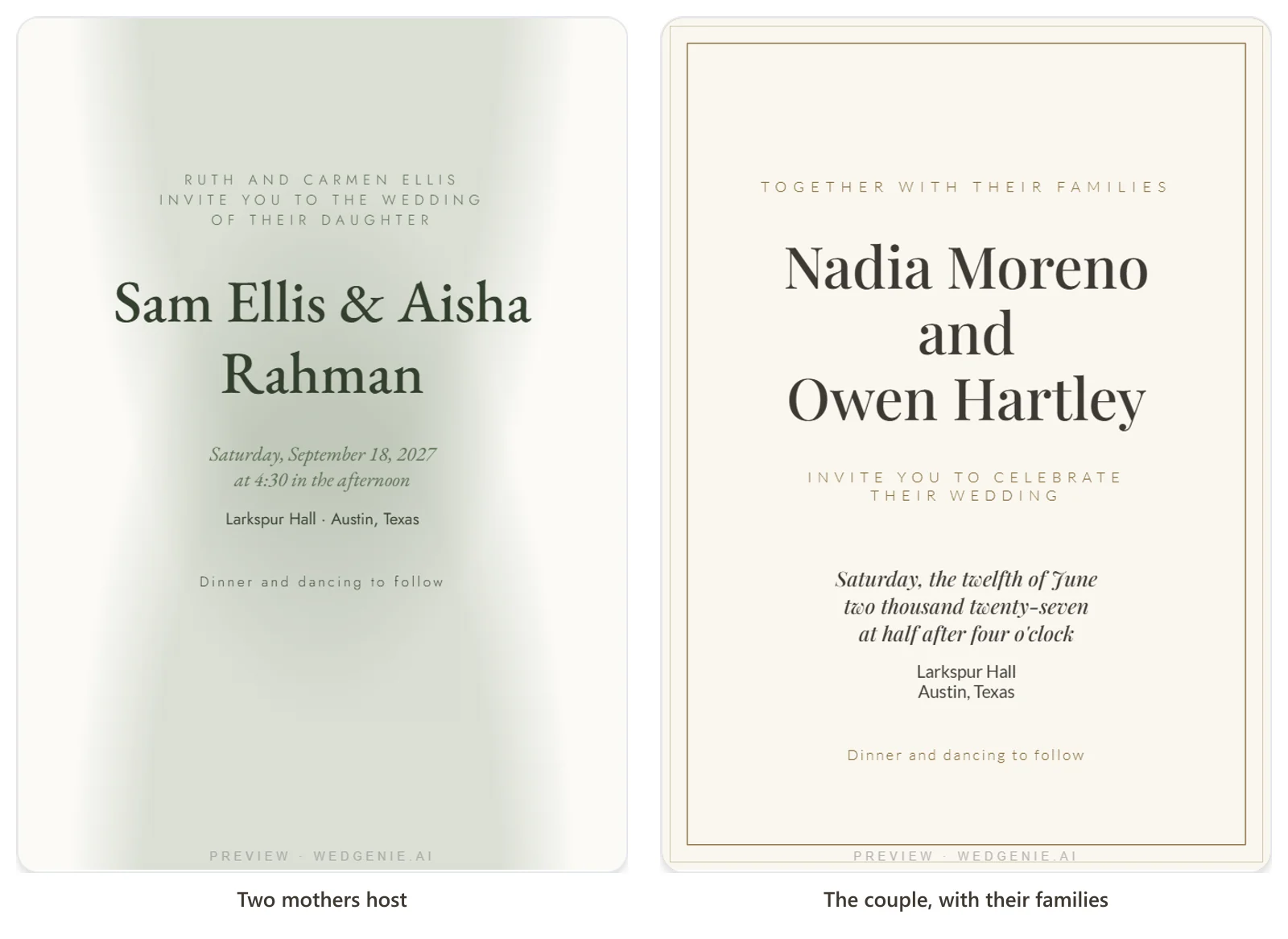
Two mothers or two fathers
Ruth and Carmen Ellis
invite you to the wedding
of their daughter
Sam Ellis & Aisha Rahman
Saturday, September 18, 2027
at 4:30 in the afternoon
Larkspur Hall · Austin, Texas
Dinner and dancing to follow
Botanical template. Each line break above is an Enter in the maker.
Zola suggests listing same-sex parents "in alphabetical order by last name"; for the couple's own names, "the choice of whose name goes first is up to you" (Over the Moon, in a post sponsored by the stationer Crane).
The couple, with their families
Together with their families
Nadia Moreno
and
Owen Hartley
invite you to celebrate
their wedding
Saturday, the twelfth of June
two thousand twenty-seven
at half after four o'clock
Larkspur Hall
Austin, Texas
Dinner and dancing to follow
Classic Serif template. Each line break above is an Enter in the maker.
This is Nadia and Owen's own card: they paid for the wedding themselves and are hosting it. "If you're hosting the wedding yourselves, this line can be omitted," The Knot says; "Together with their families" is the common way to include the parents anyway.
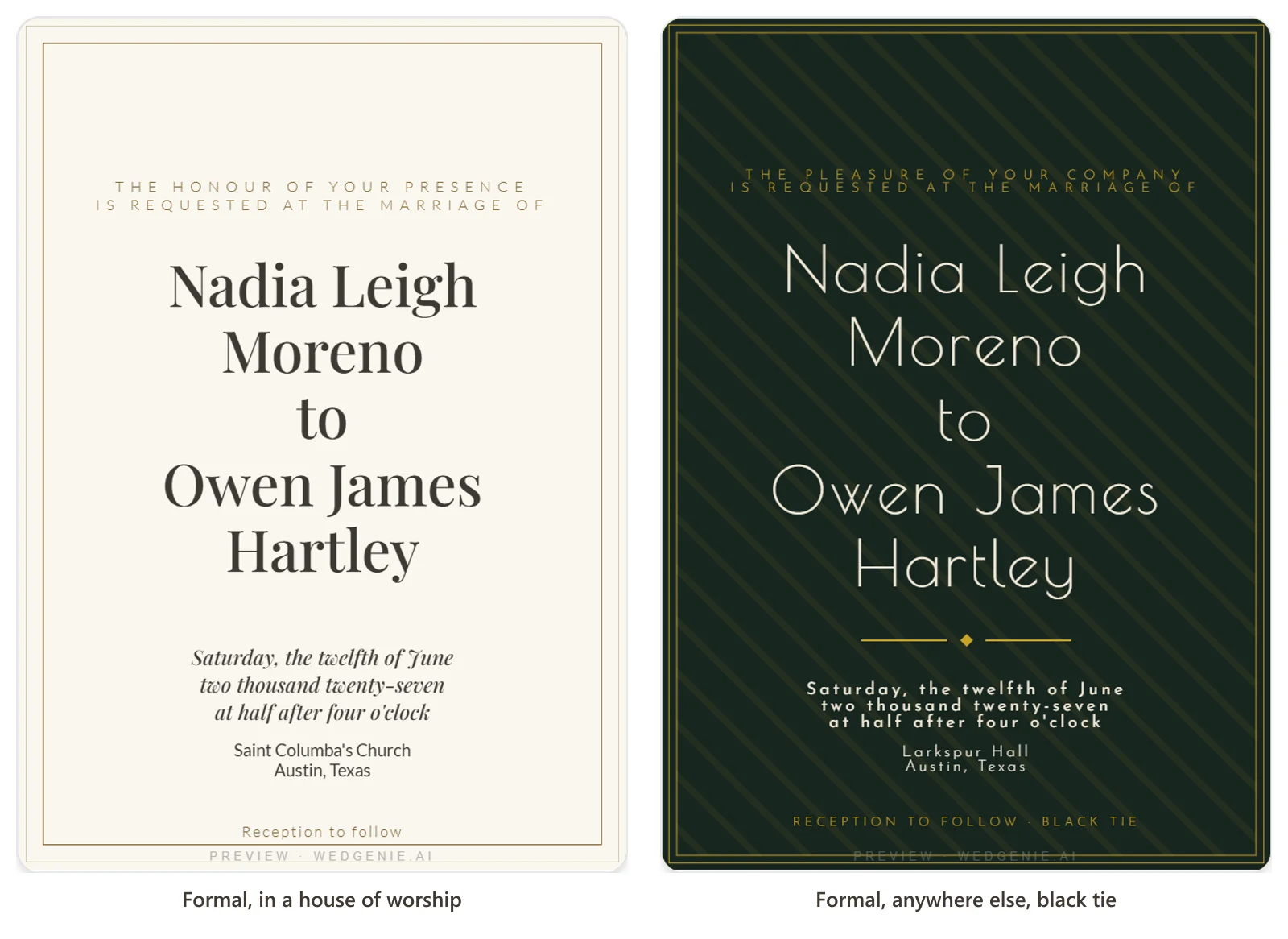
Formal wording: honour, pleasure, and spelled-out dates
Use "the honour of your presence" for a ceremony in a house of worship and "the pleasure of your company" anywhere else. Emily Post: "The phrase "the honour of your presence" is used when the ceremony will take place in a house of worship. Honour is spelled with a "u" in the British fashion. For other venues "the pleasure of your company" is the traditional wording."
The honour of your presence
is requested at the marriage of
Nadia Leigh Moreno
to
Owen James Hartley
Saturday, the twelfth of June
two thousand twenty-seven
at half after four o'clock
Saint Columba's Church
Austin, Texas
Reception to follow
Classic Serif template. Each line break above is an Enter in the maker.
The pleasure of your company
is requested at the marriage of
Nadia Leigh Moreno
to
Owen James Hartley
Saturday, the twelfth of June
two thousand twenty-seven
at half after four o'clock
Larkspur Hall
Austin, Texas
Reception to follow · Black tie
Art Deco template. Each line break above is an Enter in the maker.
The rest of the formal rules, from Emily Post: "The date is also spelled out, as is the year. Note that there is no "and": two thousand twenty-three." "The day of the week and the month are capitalized; the year is not." "Use the phrase "half after" when indicating time, rather than "half past" or "four-thirty."" At a Jewish wedding, ""and" is used instead of "to" between the bride and groom's names." Minted adds two don'ts: "Mix formal and informal language styles" and "Use ampersands (&) in traditional and very formal invitations."
Casual and modern wording
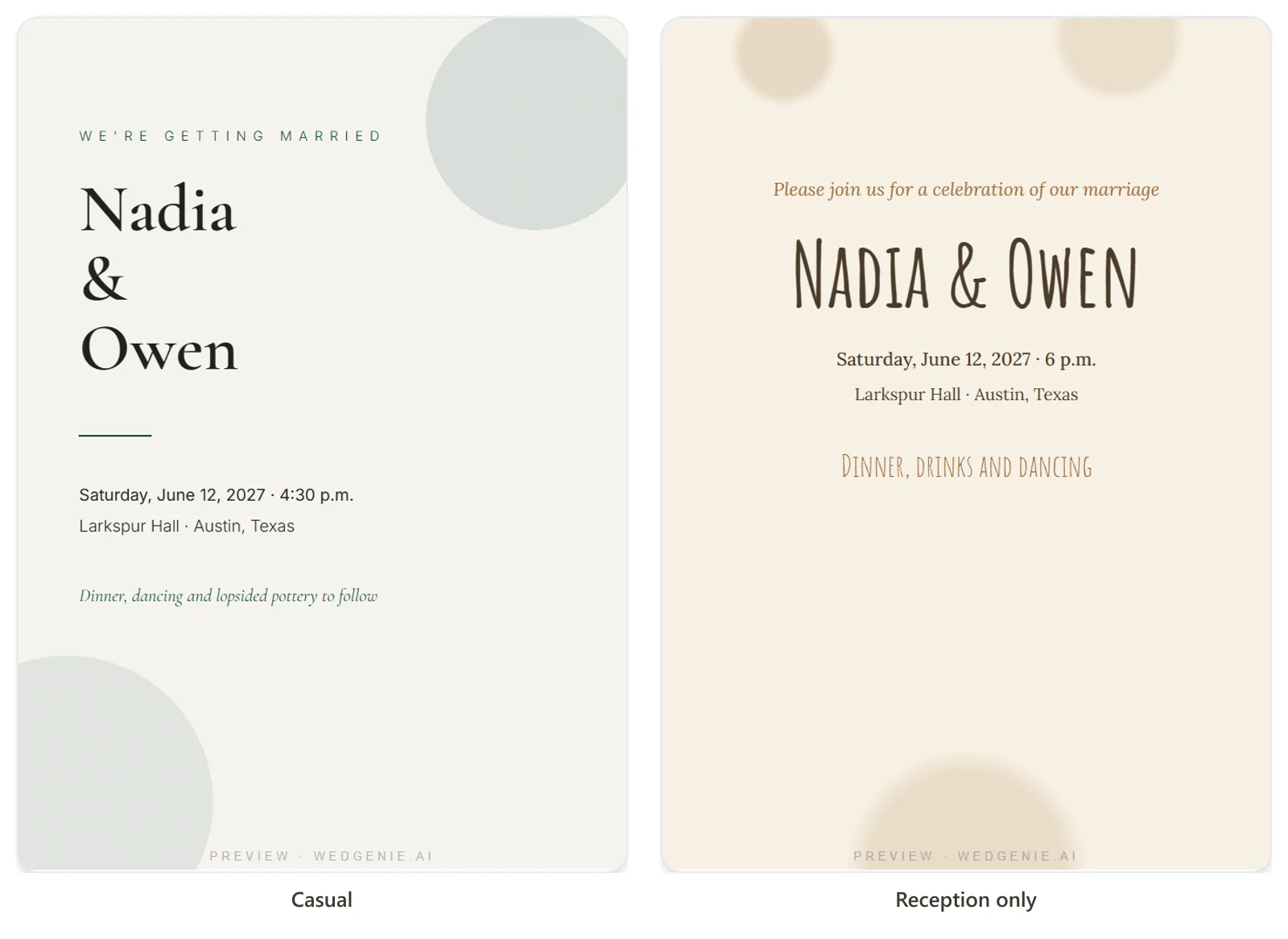
Say it in your own voice, use numerals, and keep the essentials: names, date, time, place. "Numbers should be used to convey the date and time," says The Knot for casual cards, and the tone sets the dress code before you print one: "If you're telling guests to "come eat cake" with you, it's fair for them to assume they can leave their black-tie ball gown at home."
We're getting married
Nadia & Owen
Saturday, June 12, 2027 · 4:30 p.m.
Larkspur Hall · Austin, Texas
Dinner, dancing and lopsided pottery to follow
Modern Minimal template. Each line break above is an Enter in the maker.
Reception-only wording
Make it clear the ceremony already happened. The Knot: "Wording such as "a celebration of their marriage" indicates that the ceremony has already taken place."
Please join us for a celebration of our marriage
Nadia & Owen
Saturday, June 12, 2027 · 6 p.m.
Larkspur Hall · Austin, Texas
Dinner, drinks and dancing
Rustic template. Each line break above is an Enter in the maker.
What doesn't go on the invitation
Not your registry, and usually not "adults only." Emily Post: "Don't include registry or gift information with your invitation." The Knot agrees ("Most couples do not put a registry on wedding invitations, as it is not proper etiquette. Instead, include it on the wedding website."), and so does Minted.
Children are where the guides split. Emily Post is firm: "Do not print "no children" or "adults only" on an invitation. The way an invitation is addressed, whether on the inner or outer envelope, indicates exactly who is invited." Zola says the opposite: "If you're planning a child-free wedding, write "Adults only, please" at the bottom of the invitation." The safe path is both quiet signals: address each envelope only to the adults invited (how to address them), and say it plainly on your website or a details card.
Dress code is a third split. Emily Post allows only "Black tie" in the lower right of a reception invitation; Minted says that if the wedding is black tie, "you must include that on the invitation"; The Knot says to put a dress code on the invitation or a details card because it helps guests.
RSVP, reception and details cards
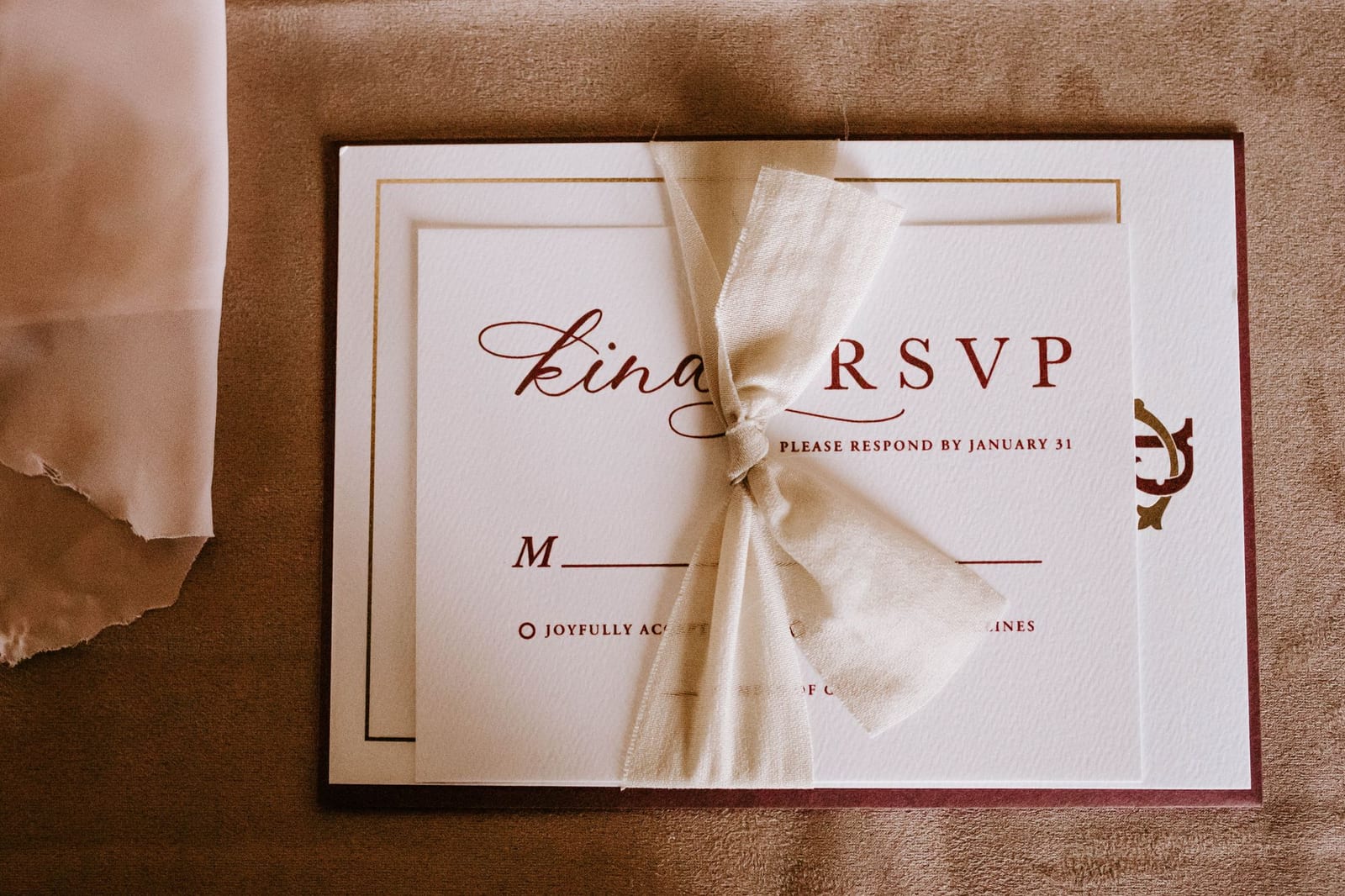
Put everything that isn't the ceremony on its own small card. The Knot: "Traditionally, only the ceremony time and location are listed on your wedding invites." A separate reception venue goes on "a separate insert card, called a reception card" (Minted), and the website goes there too, not on the main card.
Emily Post's reply card, word for word: "M____ / ___ accept(s) [or, will attend] / ___ regret(s) [or, will not attend] / The favo(u)r of your reply is requested [or, Please reply] by July 26." Match its tone to the invitation: "the favor of a reply" goes with "the honor of your presence," and with "request the pleasure of your company," the RSVP wording "would typically be "Kindly reply by" or "Kindly respond by."" (Minted). Set the deadline about four weeks before the wedding; when to send wedding invitations has the dates.
Save-the-date wording
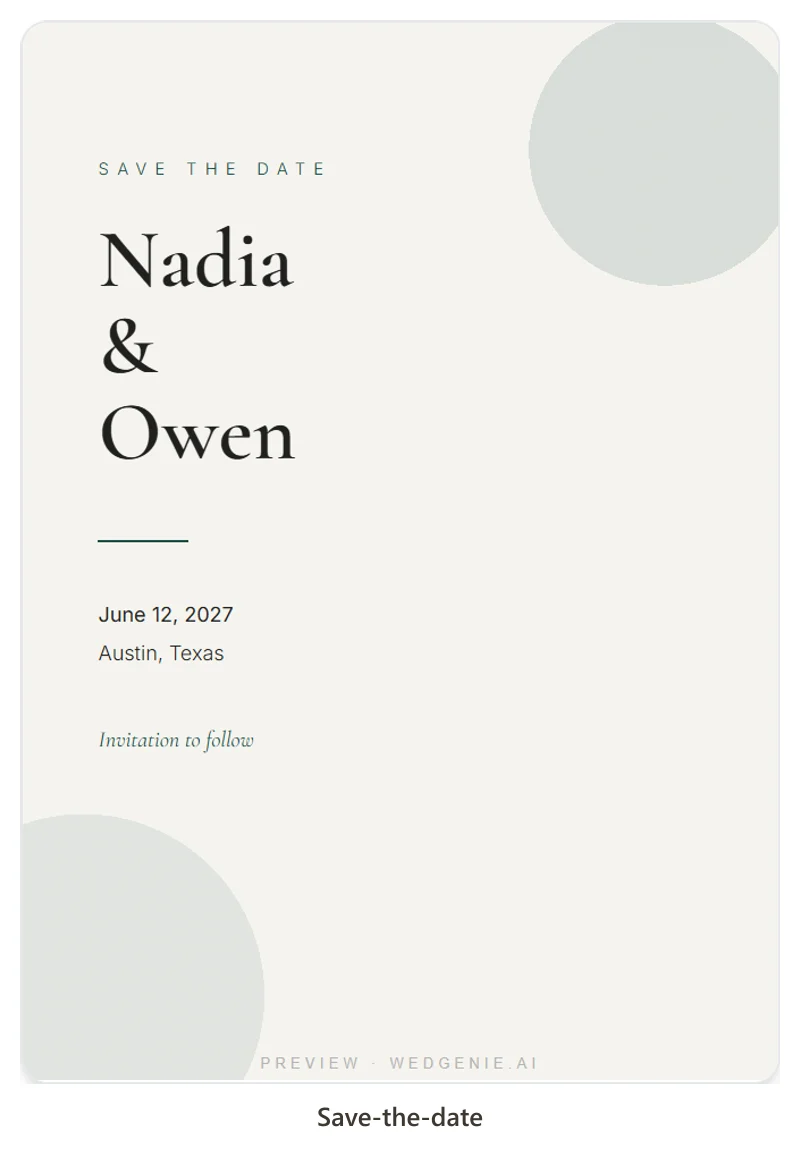
Names, date, city, and "Invitation to follow." The Knot: "guests just need the who, what, when and where," and on a casual card "It's not necessary to include last names and the date can be written solely in numbers."
Save the date
Nadia & Owen
June 12, 2027
Austin, Texas
Invitation to follow
Modern Minimal template. Each line break above is an Enter in the maker.
Check the weekday before you print
Most wording guides get it wrong in their own examples. We checked every example on ten guide pages that prints a weekday with a full date: 28 of 41 name a day the date doesn't fall on.
| Page | Example dates | Wrong weekday | One of them (the real weekday) |
|---|---|---|---|
| The Knot, wording guide | 7 | 6 | "Saturday, the seventeenth of August two thousand twenty-six" (Monday) |
| The Knot, reception-only guide | 5 | 5 | "Saturday, the ninth of January Two-thousand twenty-four" (Tuesday) |
| The Knot, date and time guide | 4 | 0 | all four correct |
| Emily Post, formal samples | 8 | 6 | "Saturday, the twenty-fifth of August two thousand fifteen" (Tuesday) |
| Emily Post, informal wording | 3 | 2 | "Saturday, October 29, 2020" (Thursday) |
| Zola | 7 | 4 | "Saturday, the fourth of July Nineteen ninety-nine" (Sunday) |
| WeddingWire | 3 | 1 | "Saturday, June 1st, 2021" (Tuesday) |
| Minted | 1 | 1 | "Saturday, the fifteenth of September, two thousand twenty-seven" (Wednesday) |
| Two stationery shops' example pages | 3 | 3 | "Saturday, June 14, 2027" (Monday) |
| All 10 pages | 41 | 28 |
These are examples on advice pages, not anyone's mailed invitation, and The Knot's date-and-time page gets every one right. But they show how easily a weekday slips past careful editors. WedGenie's free invitation maker now checks the date line as you type and tells you, for example, that June 14, 2027 is a Monday. The Genie refuses to design a card whose weekday and date disagree, before it charges anything.
Where the etiquette guides disagree
| Question | What the guides say | Our pick |
|---|---|---|
| Honour or honor? | Emily Post: honour. Zola: honour reads more formal. Minted: optional, match "favour" on the reply card. The Knot, WeddingWire: honor | Either; match the reply card |
| When to use "honour of your presence"? | Emily Post: a house of worship. WeddingWire, Minted: a religious service | A religious ceremony |
| Half after or half past? | Emily Post, The Knot: after. Minted: both. Zola, WeddingWire: past | Half after on a formal card |
| Include the year? | Emily Post: always, spelled out. Over the Moon/Crane: optional | Include it |
| "And" in the year? | Emily Post, Minted, The Knot: no. Zola and others: yes | No |
| Street address and zip code? | The Knot: full address with zip. Minted, WeddingWire: no (a home is the exception). Emily Post: city and state | Venue name, city, state |
| "Adults only" on the card? | Emily Post: never. Zola: yes, at the bottom. Minted: a line on the reception card | The envelopes, plus the website |
| Dress code on the card? | Emily Post: only "Black tie", lower right. Minted: black tie must be on it. The Knot: yes, or a details card | Only black tie or something unusual |
| A late parent? | Minted, WeddingWire: beside the child's name. Zola: also the host line | Beside the name |
Questions about invitation wording
What is the correct wording for a wedding invitation?
Host line, request, your names, date and time, venue, then "Reception to follow." Formal cards spell out the date and year; casual ones use numerals.
Is it "honour" or "honor"?
Both are correct. "Honour," the British spelling, reads more formal; if you use it, write "favour" on the reply card too.
Do you put the year on a wedding invitation?
Yes on a formal card, spelled out with no "and": "two thousand twenty-seven." Some stationers call it optional.
How do you write 4:30 on a formal invitation?
"At half after four o'clock." Emily Post says "in the afternoon" isn't necessary.
How do you say "adults only" politely?
Address each envelope only to the adults invited and say it on your website. Emily Post says never to print it on the invitation; Zola says a short "Adults only, please" at the bottom is fine.
Should the dress code go on the invitation?
Only if it's black tie or something guests wouldn't guess. Otherwise, a details card or your website.
Can you put your registry on the invitation?
No. Every guide we read says to leave it off the invitation; most put it on the wedding website.
How do you include a parent who has passed away?
Beside their child's name: "son of Rosa Bell and the late Anthony Bell." The Knot notes it isn't required.
Do you include the venue's street address?
Usually just the name, city and state. The Knot suggests the full address with zip; Minted and WeddingWire leave it off unless the venue is a private home.
Set your wording on a card — free
The examples above were set in this maker. Type your own lines, press Enter for a line break, and it checks your date's weekday as you go.
Press Enter for a new line on the card.
This free preview uses the template's built-in art. The Genie generates a custom AI art layer in your palette and a print-ready 5×7 PDF with bleed (2 credits — new accounts include 2 free trial generations). Photo cards are a WedGenie Pro exclusive: your own photo — even an AI engagement look from your Board — right on the card.
Finish it with the Genie →Live preview — your wording is set in real typefaces, never drawn by an image model.