

The short version
- Tradition put the wedding on the bride's family and the rehearsal dinner, officiant, license and honeymoon on the groom's. In The Knot's 2026 study of 10,474 couples, parents and family paid 52% of the total and the couple 48%.
- Ask each family for an amount and a date, not a line item: a promise to "pay for the venue" can mean $3,500 or $24,800, the low and high quarter of what couples spent on their venues in 2025.
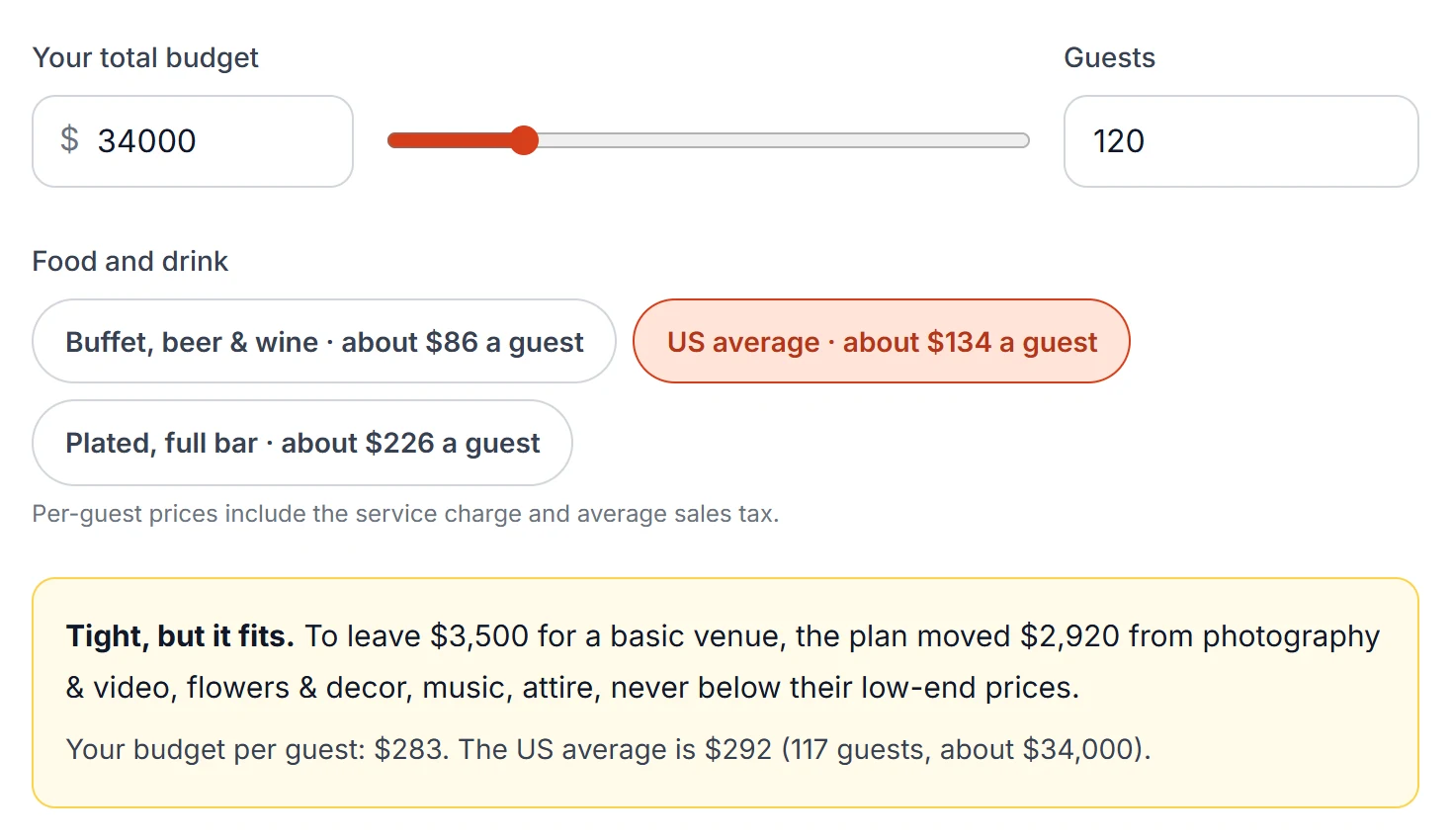
- Price every condition before you accept it. In WedGenie's free budget calculator, $10,000 from parents with 40 extra guests attached turns a tight $24,000, 80-guest plan into a tight $34,000, 120-guest plan, because those guests' food and drink alone take $5,360 of the gift.
Traditionally, the bride's family paid for the wedding and reception, and the groom's family paid for the rehearsal dinner, the officiant, the marriage license and the honeymoon. Today it's closer to half and half: in The Knot's 2026 study of 10,474 couples married in 2025, parents and family covered 52% of the total cost and the couple 48%.
So the useful question isn't which family pays for the flowers. It's how much each person is giving, when the money arrives, and what, if anything, comes attached. Below are the traditional lists, what families actually paid, where the sources disagree, and the math on a gift with conditions, run through WedGenie's free budget calculator.
Who traditionally pays for the wedding?
Tradition put the wedding and reception on the bride's family, and the rehearsal dinner, officiant, marriage license and honeymoon on the groom's. Emily Post sums it up: "The bride's family paid for the groom's ring, engagement party, the wedding and reception, a brunch the next day, and a belated reception (if there was one). The groom's family financed the rehearsal dinner, the officiant's fee, marriage license, and the groom paid for the bride's engagement and wedding rings and honeymoon."
The table above has the full lists and the places where the guides disagree. Treat them as a starting point, not a rule. Emily Post itself says "all of the following guidelines for family expenses are variable," and The Knot notes its list is "purely based on heteronormative tradition."
Who actually pays for a wedding today?
In 2025, parents and family covered 52% of the average wedding's cost and couples covered 48%, according to The Knot's 2026 study. The family share splits roughly 38% from the couple's own parents and family and 14% from the partner's.
Who paid for US weddings in 2025, share of the total cost
- The couple48%
- Their own parents and family38%
- Their partner's parents and family14%
The couple's share has grown: in 2016, The Knot found "the bride's parents contribute 44% of the overall wedding budget, the bride and groom contribute 42%, and the groom's parents contribute 13%." For 2024 weddings it reported that "86% of parents contributed to wedding costs." Big weddings lean hardest on family: couples who spent over $41,000 had "family contributions (covering 62% of the bill)," while weddings under $12,000 were mostly self-funded.
Not every survey agrees. LendingTree asked 1,050 newlyweds in March 2025 how they mainly paid: 46% said savings, 24% credit cards and only 16% "help from parents/relatives." The two measure different things (share of the dollars versus the main source) and different people: The Knot surveys its own members, whose average age is 32, while LendingTree's sample ran from 18 to 79 and included second marriages. More numbers like these, each with its source, are in our wedding statistics.
What does the bride's family pay for?
Traditionally the ceremony, the reception and most of what guests see: the venue, food, flowers, music, photography, invitations and her dress. Emily Post's list also includes "Services of a wedding consultant," transportation for the wedding party, the bridesmaids' luncheon and the groom's ring.
Today, the right answer is whatever they offer. Zola's rule is the one to keep: "Never assume that someone can or will contribute financially." If the dress is the gift, the wedding dress cost guide shows what that usually means in dollars.
What does the groom's family pay for?
Traditionally the rehearsal dinner, the officiant's fee, the marriage license, the groom's attire, flowers for the wedding party and the honeymoon. The rehearsal dinner is the big one, and even that is "customary, but not obligatory," says Emily Post: "If the groom's family chooses not to host, then it's fine for the bride's family, or the bride and groom to do so. It's also perfectly fine for the two families to host together." Her one firm rule: "the rehearsal should never be more formal or more lavish than the wedding reception."
What a rehearsal dinner cost in 2024
- Weddings with 50 or fewer guests$1,630
- All couples who hosted one$2,700
- Weddings with over 100 guests$3,139
- Destination weddings$3,838
Over 74% of couples hosted a rehearsal dinner for their 2024 weddings, according to The Knot, and whoever hosts it decides it: "Since the groom's family is paying for these events, they control how it's organized." Note that a rehearsal dinner sits outside the wedding budget in most plans, WedGenie's calculator included. The officiant's fee is smaller than people expect; see what an officiant costs.
What the couple and the wedding party pay for
Each partner traditionally buys the other's ring, the couple pays for gifts and extra weekend events, and attendants pay for their own outfits and travel. Emily Post lists the bridesmaids' share as "Purchase of apparel and all accessories" and the groomsmen's as "Rental or purchase of wedding attire," both with their own travel. Guests cover "Lodging expenses and meals." If you require bridesmaids to have their hair and makeup done professionally, The Knot puts that bill on the bride, her family or the couple; prices are in our hair and makeup cost guide.
Set the number before you book anything
Ask everyone for a fixed amount and a date first, add it up, and plan to that total. Emily Post calls it "the first and most important step": "find out who is willing to pay for what, and how much everyone is able to contribute, which in turn will provide you with an overall spending limit with which to work."
Turn every line-item offer into dollars. "We'll pay for the venue" sounds generous and settles nothing, because venue prices run across a huge range:
What "we'll pay for the venue" can mean
- Starting prices US venues publish, middle half (WedGenie)$2,100–$7,450
- Median published starting price (WedGenie)$4,000
- What couples spent on the venue, low to high quarter (The Knot)$3,500–$24,800
- Average venue spend (The Knot)$12,900
Therapist Landis Bejar, in The Knot, suggests leaving the first conversation "knowing exactly what your family will contribute, when they will share the money, what their preferred form of payment is, and how they would like their funds to be used, if applicable," and putting it in "a chart or a wedding planning spreadsheet." Here is that chart, filled in for one fictional couple, Elena and Marcus:
| Who | Amount | When it arrives | Paid how | For what | Conditions |
|---|---|---|---|---|---|
| Elena and Marcus | $24,000 | Saved already | Our account | Anything | None |
| Elena's parents | $10,000 | By March 1 | To us | Anything | 40 more guests |
| Marcus's parents | Rehearsal dinner | They host it | Direct to the restaurant | The dinner | They choose the place |

When the money comes with conditions
Price every condition before you accept it; the most common one, extra guests, can cost more than the gift. Elena and Marcus have $24,000 for 80 guests. Elena's parents offer $10,000, and they'd like to invite 40 more people. Here is what WedGenie's budget calculator does with each version, at US-average food and drink of $134 a guest unless noted:
| Couple alone: $24,000, 80 guests | Gift, no strings: $34,000, 80 guests | Gift + 40 guests: $34,000, 120 guests | Gift + 40 guests, buffet and beer and wine | |
|---|---|---|---|---|
| Calculator says | Tight, but it fits (moved $2,460) | Fits | Tight, but it fits (moved $2,920) | Fits |
| Venue and rentals | $3,500 | $5,940 | $3,500 | $6,340 |
| Catering and bar | $10,720 | $10,720 | $16,080 | $10,320 |
| Photography and video | $1,535 | $3,400 | $2,383 | $3,400 |
| Flowers and decor | $940 | $2,720 | $1,747 | $2,720 |
| Music | $825 | $2,040 | $1,377 | $2,040 |
The 40 extra guests' food and drink alone cost $5,360, more than half the gift. With them, the venue stays at its $3,500 floor and the verdict stays "Tight, but it fits." Without them, the gift moves the plan from tight to fits and puts $2,440 more into the venue and $1,865 more into photography. The last column is the honest compromise: accept the guests and change the menu.
One caveat: the calculator doesn't charge more for a bigger room as the list grows. In The Knot's data, couples with more than 100 guests spent $16,000 on the venue on average, against $10,400 for 51 to 100 guests, so the real cost of those 40 guests is likely higher.
Etiquette is on the parents' side here, within reason. Emily Post: "If you cannot afford more people and your future in-laws offer to pay for additional guests, it's fine to graciously accept." She also notes that extra guests may "require you to change the reception site, potentially losing deposits," and that "Some couples ask parents to agree only to invite guests the couple themselves know."
Does paying buy a say? The guides split. Emily Post: "Parents need to remember that the wedding belongs to the couple, regardless of who is paying. Parents can make suggestions, but the specific choices of colors, food, flowers, music, and design are up to the bride and groom." WeddingWire is blunter: "money equals control." Settle it before any money moves, not after.

Divorced parents, stepparents and blended families
Talk to each household separately, each partner with their own parents, and agree on whose names go on the invitation before it prints. Emily Post notes the money talk "usually involve[s] the couple, their parents, and any stepparents," and that the idea of the groom's parents contributing "is best broached by the groom directly (and privately) with his parents." On invitations, Zola's rule of thumb is that "The hosts are typically the people who are paying for the wedding," so a household that pays may expect its names on the card.
Same-sex couples and couples marrying later
The gendered lists don't apply, so couples set the shares themselves, and more of them pay on their own. In WeddingWire's 2020 report, LGBTQIA+ couples paid "61% of wedding expenses themselves, while their parents pay for 37%"; Gen X couples paid 78%, and couples in a second wedding 88%. The Knot links the shift to age: "Because people are getting married later in life, some couples are more financially equipped to take on more (or all) of the wedding costs themselves."
How to ask your parents for help
Ask, don't assume: one conversation, early, that ends with an amount, a date and any conditions written down. Bejar suggests opening with "'Are you able to help us with the cost of the wedding?' or 'Did you have a budget in mind or specific elements you would like to contribute towards?'" because "This approach allows parents to want to contribute and not feel like an ATM."
Give them room. "It's okay not to commit a number the first time money comes up," Emily Post tells parents, and Zola's rules run the other way too: "Never pressure anyone to pay for your wedding" and "Always let the other person decide how much (if anything) to contribute." Bejar adds a warning worth passing on: "if this is a parent's first wedding since planning their own, they might be very shocked about what it means to volunteer to cover catering."

Do the math on your own total
Add up what's been promised, type it into the free wedding budget calculator with your guest count, and it tells you in a second whether the list fits and what each line gets. It takes one total, so add the contributions up first. The Genie keeps the contribution sheet itself on your Wedding Board: who is giving how much, by when, on what terms, and whether it has arrived, set against the total. It also flags a choice that squeezes another line and drafts the message to your parents. For the split behind the calculator, see how to split a wedding budget; if nobody can help, planning a wedding on a budget shows what each cut saves.
Questions about who pays
Who pays for the wedding in the US today?
Parents and family covered 52% of the average 2025 wedding's cost and the couple 48% (The Knot, 10,474 couples). Most weddings are shared.
What does the bride's family traditionally pay for?
The ceremony and reception, invitations, flowers, music, photography, the bride's dress and the groom's ring.
What do the groom's parents pay for?
Traditionally the rehearsal dinner, the officiant's fee, the marriage license, the groom's attire, the wedding party's flowers and the honeymoon. In some regions they also pay for the bar or the band.
Who pays for the rehearsal dinner?
Traditionally the groom's family, though Emily Post calls it "customary, but not obligatory." It averaged $2,700 for 2024 weddings (The Knot).
Who pays for the wedding rings?
Each side traditionally buys the other's ring: the bride's family the groom's ring, the groom (or his family) the bride's engagement and wedding rings.
Who pays for the wedding dress and the bridesmaid dresses?
The bride's family traditionally pays for her dress; bridesmaids buy their own.
Do parents who pay get a say?
On what they pay for, often yes; on the whole wedding, no. Emily Post: the wedding "belongs to the couple, regardless of who is paying." Agree on conditions before the money moves.
How much do parents usually contribute?
About half the total on average, though no reliable US survey gives an average dollar amount. Multiplying 52% by The Knot's $34,000 average gives a number nobody actually paid.
Who pays for the honeymoon?
Traditionally the groom and his family; today, WeddingWire says, "the couple is usually taking on those expenses."
What if our parents can't help?
Plan to what you have. Planning a wedding on a budget shows what each cut saves, starting with the guest list.
Run your own numbers — free
The plans above came out of this calculator. Type your total and your guest count: it says whether the list fits and where every dollar goes, nothing uploaded.
Tight, but it fits. To leave $3,500 for a basic venue, the plan moved $2,200 from photography & video, flowers & decor, music, attire, never below their low-end prices.
Your budget per guest: $300. The US average is $292 (117 guests, about $34,000).
Breakdown — $30,000 total, 100 guests (starting split from what US couples spend)
| Venue & rentals | 12% | $3,500 |
| Catering & bar | 45% | $13,400 |
| Cake & desserts | 1% | $300 |
| Photography & video | 7% | $2,231 |
| Flowers & decor | 5% | $1,633 |
| Music | 4% | $1,289 |
| Attire | 4% | $1,347 |
| Hair & makeup | 1% | $300 |
| Rings | 5% | $1,500 |
| Planner, officiant & misc | 4% | $1,200 |
| Invitations & stationery | 1% | $300 |
| Transport | 2% | $600 |
| Tips & fees | 3% | $900 |
| Buffer | 5% | $1,500 |
| Total | 100% | $30,000 |
Make it live: the Genie turns this split into a real budget and tracks it against actual vendor quotes as you book.
Make it a live budget →The split is what 10,474 US couples actually spent (The Knot 2026 Real Weddings Study), with 3% held for tips and fees and a 5% buffer. Catering is sized from your guest count; the venue gets the rest of the venue-and-food half. Sources and reasoning are in the budget breakdown guide.