

The short version
- The guides agree on five things: the officiant is at the front first, attendants walk in from the outside in, the maid of honor and best man come last of the attendants, the children walk just before the bride or the couple, and guests stand for the last entrance.
- They disagree on who comes first and where the parents fit: The Knot's two guides put the groom before and after the parents, WeddingWire seats the parents before anyone walks, and at Jewish weddings both parents walk each partner and stand under the chuppah.
- The faiths leave room: the US bishops' 2016 guidance says the procession takes place "in the customary manner", Chabad calls the order "not important to the law", and the recessional runs in reverse, couple first.
The usual wedding processional order is the officiant, then family, then the attendants from the outside in, the children, and the bride last with her escort. But the five guides we read publish five different "traditional" orders, and no faith requires one. "None of the religious traditions require a specific processional order," Cathleen O'Connell told The Knot.
Below are the rules every source agrees on, the places they don't, and the orders for Christian, Catholic, Jewish and two-partner ceremonies, with the recessional. Every diagram is drawn from the guests' seats, with the front at the top, and every walker's number sits on the spot where they end up. Settle the order with your officiant, then walk it once at the rehearsal.
The order everyone agrees on
Five rules hold in every guide we read; the rest is your choice.
- The officiant is at the front before the wedding party walks. "The officiant enters before the wedding party and awaits the couple at the altar" (WeddingWire).
- Attendants walk in from the outside in. "The first groomsman or bridesmaid to walk down the aisle will stand the farthest away from the couple, so the best man and maid of honor will stand directly next to the couple" (Rev. Orsella Hughes, The Knot).
- The maid of honor and best man come last of the attendants. "The maid of honor and best man should be the final wedding party members to walk down the aisle" (The Knot).
- The children walk just before the bride, or the couple. "The ring bearer and/or flower girl round out the wedding procession right before the bride enters" (The Knot).
- Guests stand for the last entrance. The Knot's advice: "have the guests stand once the bride makes her entrance or you can go about that scenario however you please."
Beyond those, the guides differ, and The Knot differs from itself:
| Source | The order as published |
|---|---|
| The Knot, processional guide (2025) | Officiant, groom, grandparents, groom's parents, mother of the bride, wedding party, children, bride and father |
| The Knot, ceremony-order guide (2025) | Groom's parents, mother of the bride, groom, best man and maid of honor walking together, attendants in pairs, children, bride and father |
| WeddingWire (2021) | Groom's parents and mother of the bride seated first, then officiant, groom and best man, attendants, maid of honor alone, children, bride and father |
| Zola (2024) | Mother of the bride, groom alone, best man, groomsmen, bridesmaids, maid of honor, children, bride and father; "that's not to say it has to go in this order" |
| Minted (2025) | Officiant, groom, best man, groomsmen, bridesmaids, maid of honor, children, bride and father, with parents seated "Right before the ceremony is about to begin" |
The differences come down to two choices: whether parents and grandparents walk or are seated by ushers before the music, and whether the groom walks the aisle or enters from the side. Neither is wrong.
Christian and Protestant processional order
The officiant and groom are in place first and the bride walks last with her escort, whether the groom enters from the side or walks the aisle. This is the order The Knot's processional guide gives, drawn where each person ends up:
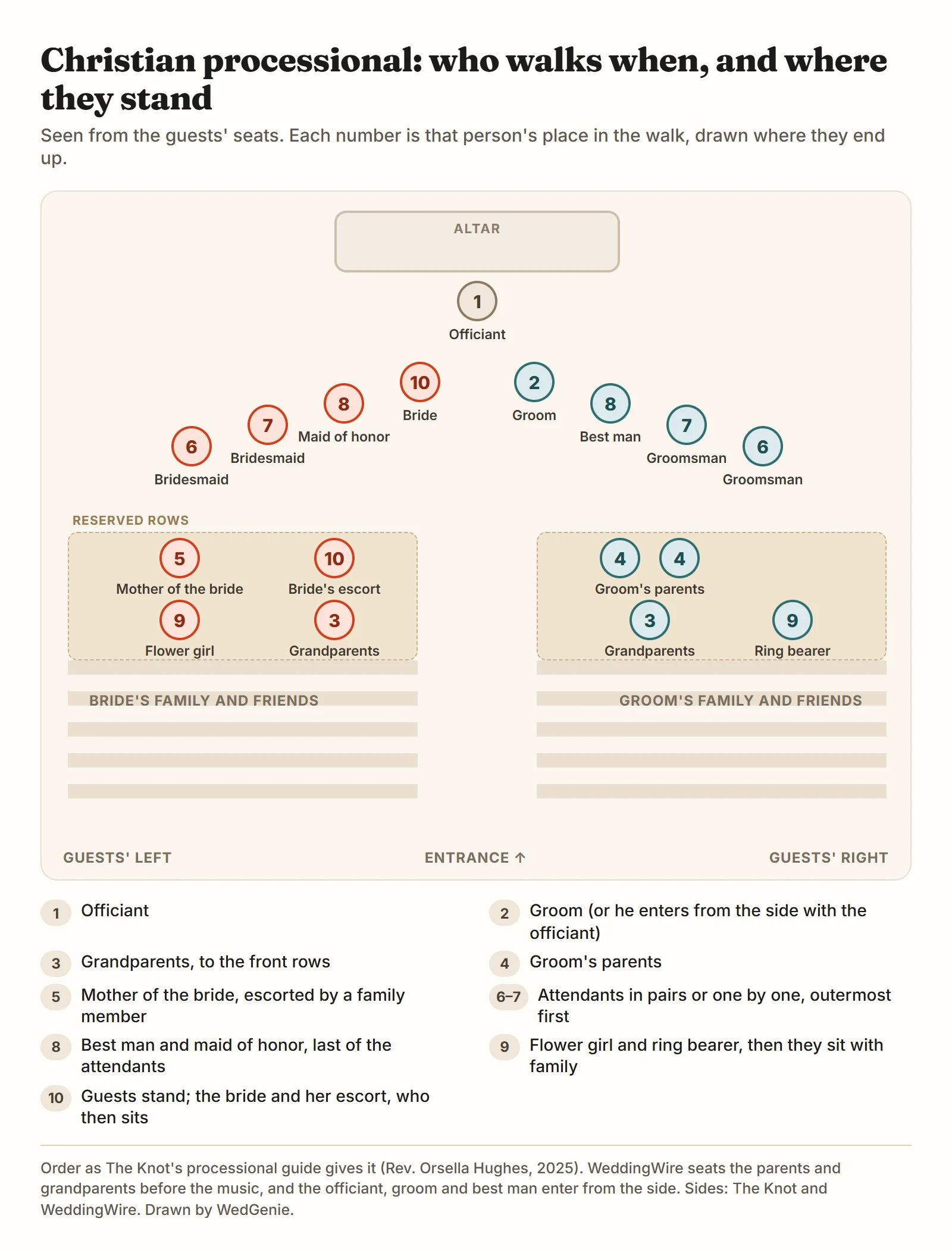
- Officiant
- Groom (or he enters from the side with the officiant and the best man)
- Grandparents, to the front rows
- Groom's parents
- Mother of the bride, "traditionally escorted by another family member, like a son or brother" (The Knot)
- and 7. Attendants, in pairs or one by one, outermost first
- Best man and maid of honor, last of the attendants
- Flower girl and ring bearer, who then sit with family or stand with the wedding party
- Guests stand; the bride and her escort, who then takes his seat
The other common version, WeddingWire's, seats the grandparents and parents before the music, the mother of the bride last of them: "the last person seated before the officiant, groom and best man take their places at the altar." The groom and best man come in from the side, and the maid of honor walks alone: "It's a misconception that the maid of honor walks with the best man during the processional—in reality, she walks down the aisle alone." The Knot's ceremony-order guide pairs them, so both happen.
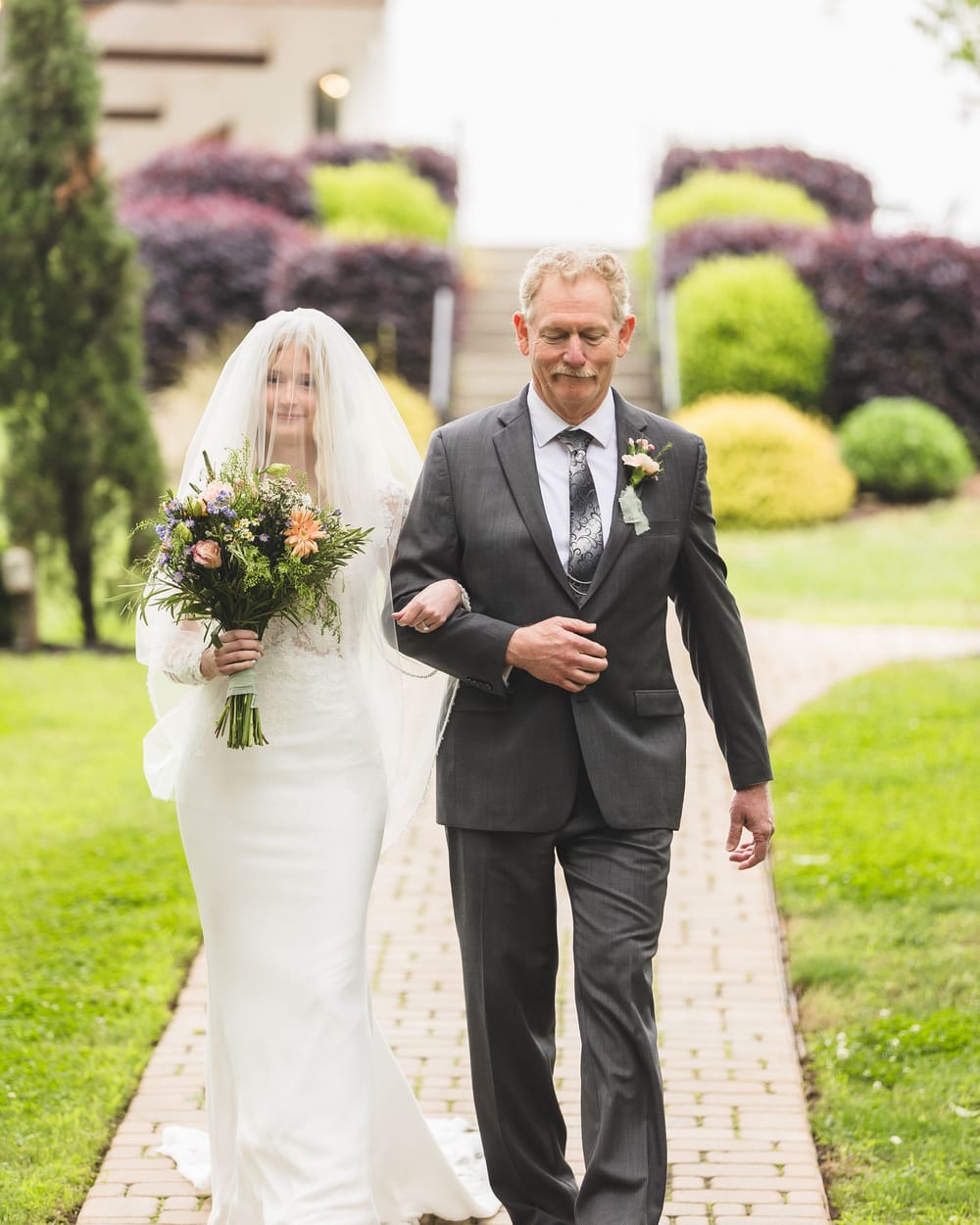
Who stands where at the altar
Seen from the guests' seats, the bride stands on the left in a Christian ceremony; in a Jewish ceremony she stands at the groom's right hand. "From the guests' POV, it's customary for the bride to stand on the left side in a Christian wedding ceremony, and the groom on the right—and in turn, the couple's families will sit on their respective sides," says The Knot. WeddingWire adds that they stand "both facing the officiant," and Minted has the officiant "in the center."
The attendants fan out behind each partner, best man and maid of honor closest. The Knot notes that "some couples are opting to flip this," with attendants standing behind the other partner, and that ushers usually "sit in one of the first rows." One small touch from Laura Cannon, in the same guide: seat each set of parents on the "opposite" side of the aisle from their child, "so they can see their own child's face."
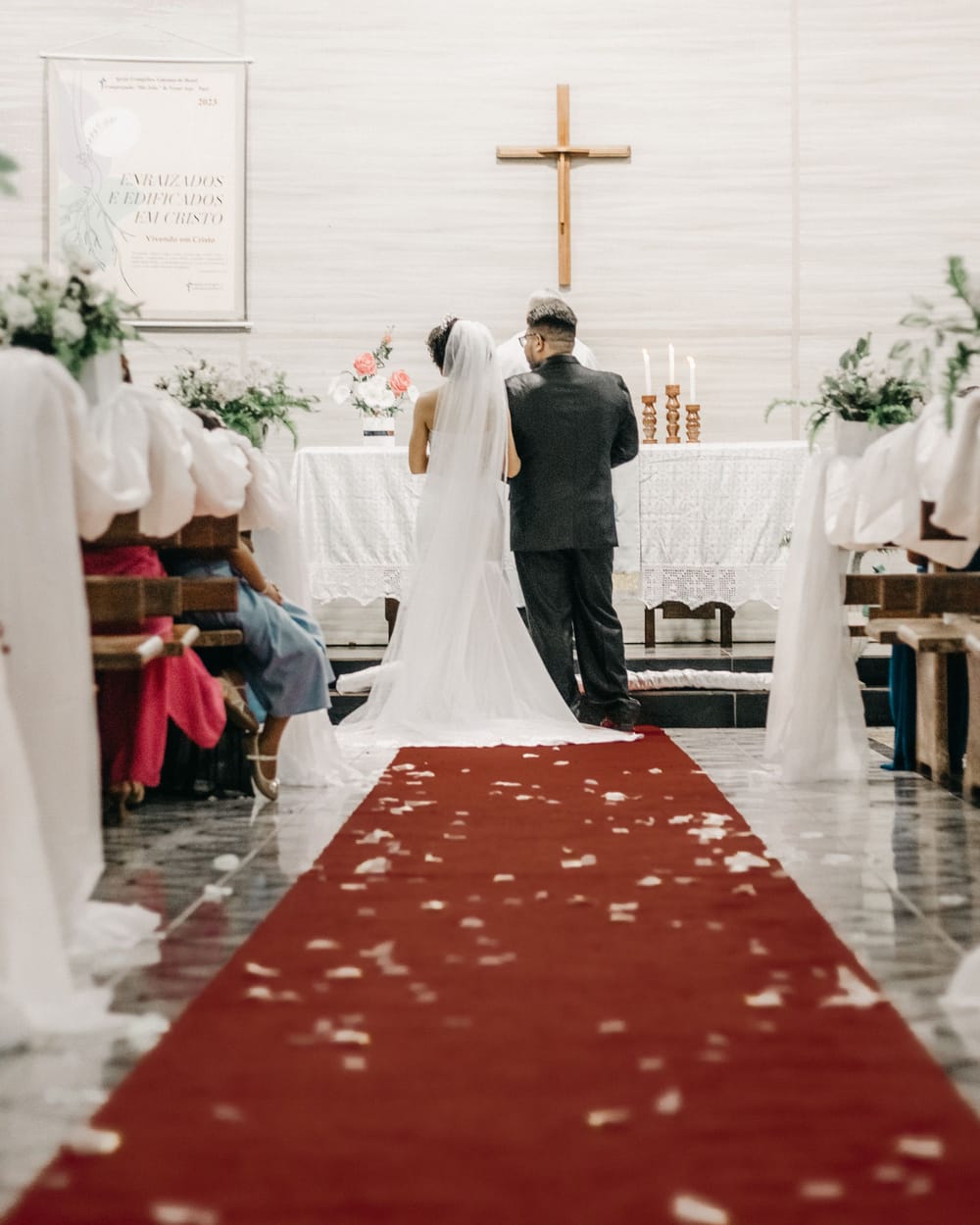
A trap worth knowing: "left" and "right" flip with the viewpoint. The Knot puts the bride on the right at a Jewish wedding, which assumes the couple faces the rabbi with their backs to the guests. In My Jewish Learning's traditional description, the couple faces the guests, so the bride, still at the groom's right hand, appears on the guests' left. If a guide says "right" without saying from where, ask.
Most traditions "don't even have 'sides'" for guests, Cannon adds; for two partners, "There are no specific sides for the couple or the guests."
Catholic processional order
The priest, groom and best man usually enter from the side, then the families, the attendants in pairs and the bride with her father; your parish decides. The Knot's Catholic order:
- "The priest, groom and best man (in that order) will enter the church from a side door." In some churches, all the groomsmen do too.
- The groom's parents walk to the front row on the right.
- The mother of the bride walks to the front row on the left.
- The attendants walk "in pairs, with the bridesmaids on the left and the groomsmen on the right," and split at the front.
- The maid of honor.
- The ring bearer and/or flower girl.
- The bride with her father or chosen escort.
The church's own text is looser than any wedding site. The US bishops' Committee on Divine Worship explained in 2016 that the old rite described a procession ("the ministers go first, followed by the priest, and then the bride and bridegroom," escorted by "at least their parents and the two witnesses"), while the current English text says only: "The procession to the altar then takes place in the customary manner." In their words, "there remains considerable latitude in the details and order of procession." Ask your parish what it expects.
Jewish processional order
Rabbi, grandparents, the groom's attendants, the groom with both parents, the bride's attendants, then the bride with both parents; the groom must arrive first. The Knot, Zola, WeddingWire and Minted all give this order, with the couple "escorted down the aisle by both parents, who stand under the chuppah."
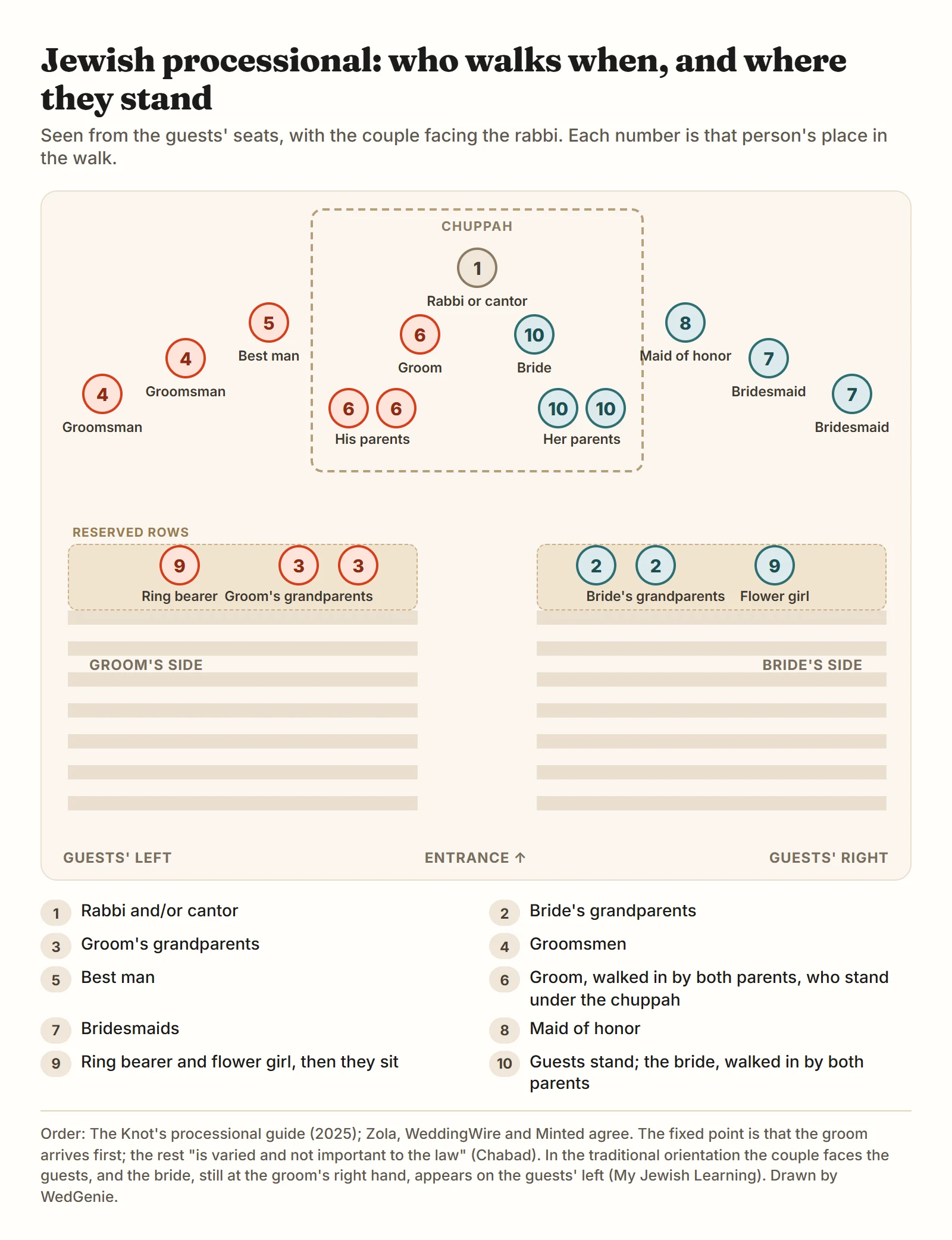
- Rabbi and/or cantor
- The bride's grandparents (front row, bride's side)
- The groom's grandparents (front row, groom's side)
- Groomsmen, to the left of the chuppah
- Best man
- The groom, walked in by both parents, who stand under the chuppah
- Bridesmaids, to the right
- Maid of honor
- Ring bearer and flower girl, who then sit
- Guests stand; the bride, walked in by both parents
Only one step is fixed. "The groom must arrive under the chuppah before the bride," writes Maurice Lamm for Chabad, and "The order of the procession, the people chosen, and the decor are varied and not important to the law." Escorts are custom, not law: "Traditional escorting is not sacrosanct; it does not have even the rank of rabbinic law." There is no Jewish tradition of a father giving the bride away, and if divorced parents won't walk together, Lamm suggests reverting "to the tradition of both fathers escorting the groom and both mothers the bride."
Under the chuppah, "Some circle three times, others circle seven times" (Chabad); in many contemporary weddings, "each partner circles the other, often three times each, followed by a final circle together" (ReformJudaism.org).
Same-sex couples and other entrances
There is no fixed order: one partner waits, both walk at once on two aisles, or you walk in together. Maureen Cotton, in The Knot, puts the question simply: "Does one of them prefer to enter first, as a groom often does, with the other entering last as the climax of the processional, like a bride often does? Or do they want to walk in together?" WeddingWire and Zola describe a third way; in Zola's words, "set up multiple aisles. This way, you can both walk down your aisles at the same time, symbolically meeting in the center."
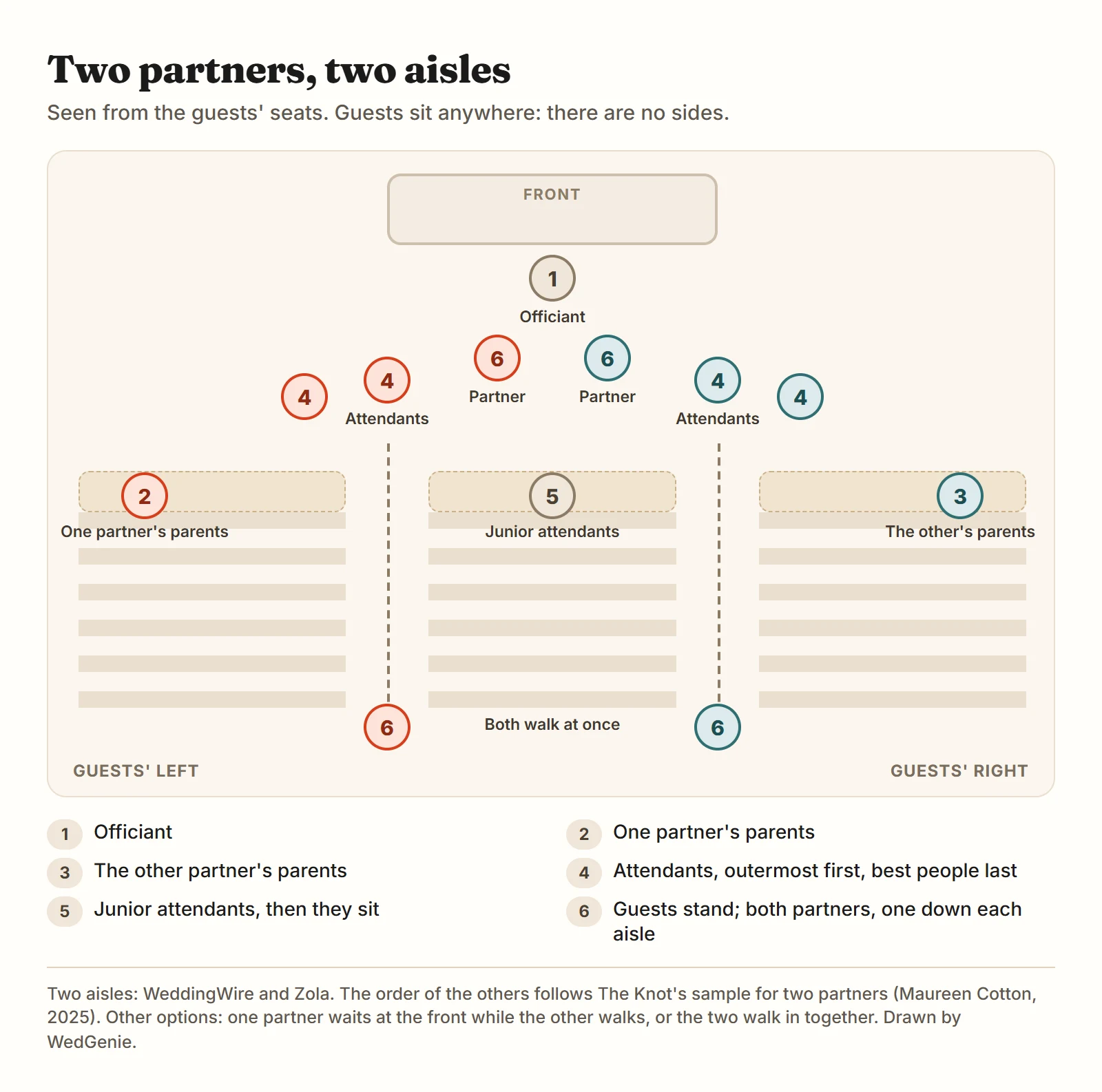
- Officiant
- One partner's parents
- The other partner's parents
- Attendants, outermost first, best people last
- Junior attendants, who then sit
- Guests stand; both partners, one down each aisle, meeting at the front
Who walks with whom
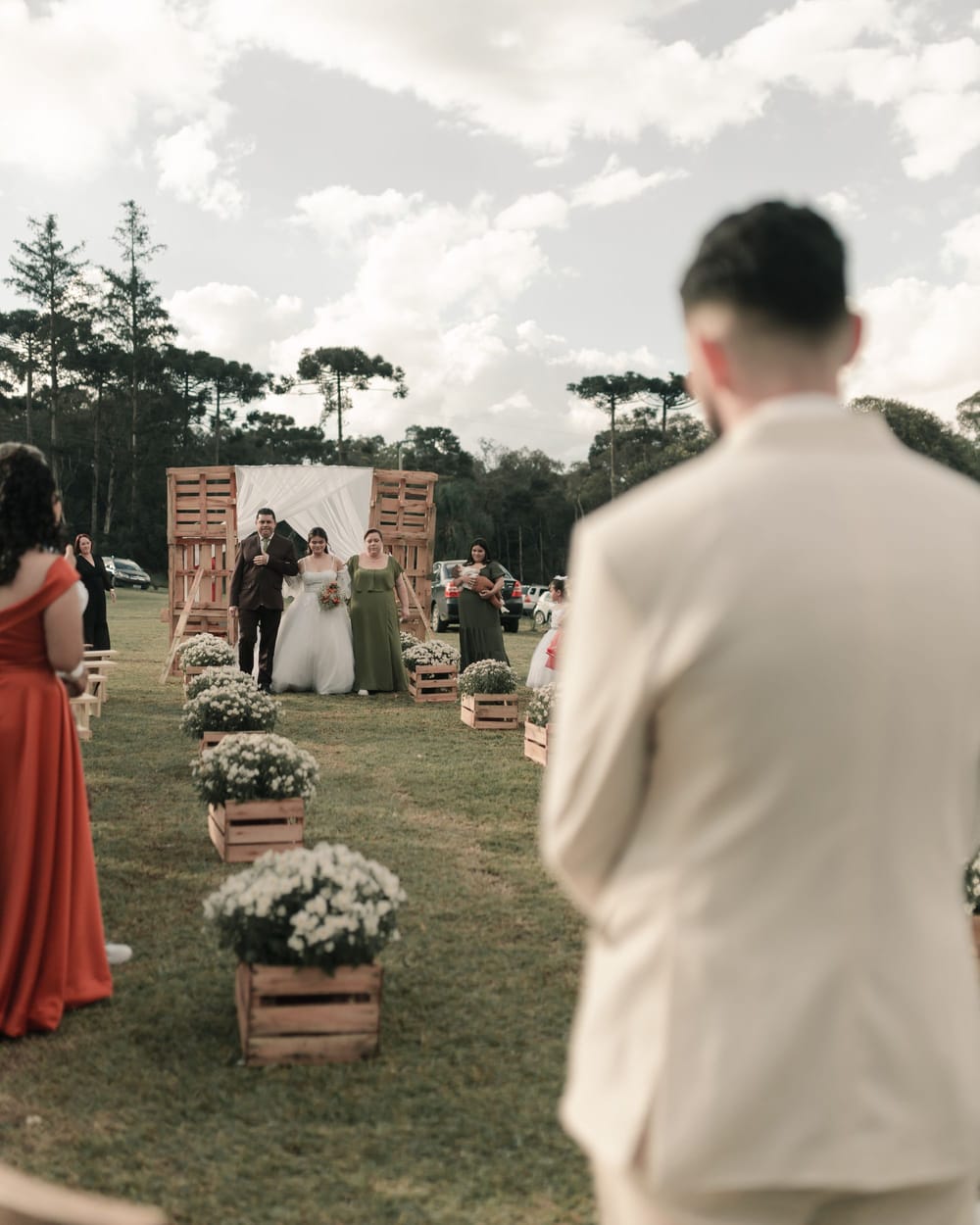
- The bride: traditionally her father, but "it's perfectly fine for a bride to have her mother escort her or to walk down the aisle alone" (Emily Post). With two fathers, Emily Post suggests one walks her halfway and the other the rest. Which arm she takes varies by guide; your officiant will say.
- The groom: "Traditionally, he walks down the aisle solo, but some grooms prefer walking down the aisle escorted by both parents. Other grooms prefer to enter the ceremony from the side" (Minted). At Jewish weddings, both parents walk him in.
- The mother of the bride: "She can walk alone or be escorted by her son, son-in-law or another relative" (WeddingWire).
- The groom's parents: together, before the mother of the bride, when they walk at all.
- The children: flower girls are "usually between the ages of 3 and 8" and ring bearers "often between the ages of 6 and 12" (The Knot). Minted suggests decoy rings, with "the best man would hold the actual rings."
The recessional order
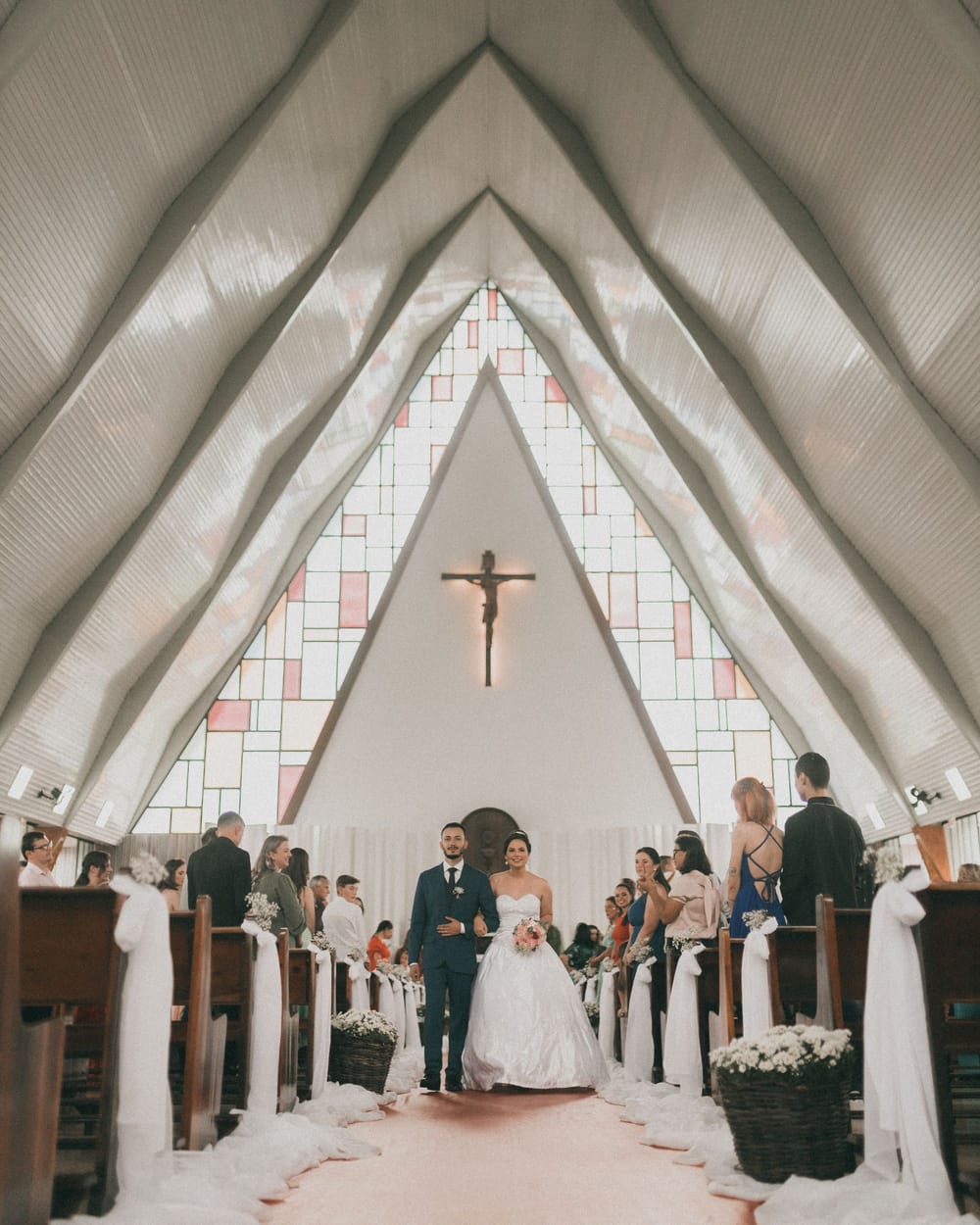
The couple leaves first, then the attendants in pairs from the center out, then parents, grandparents and the officiant. The Knot's rule is the simplest: "Follow the reverse of the wedding processional order."
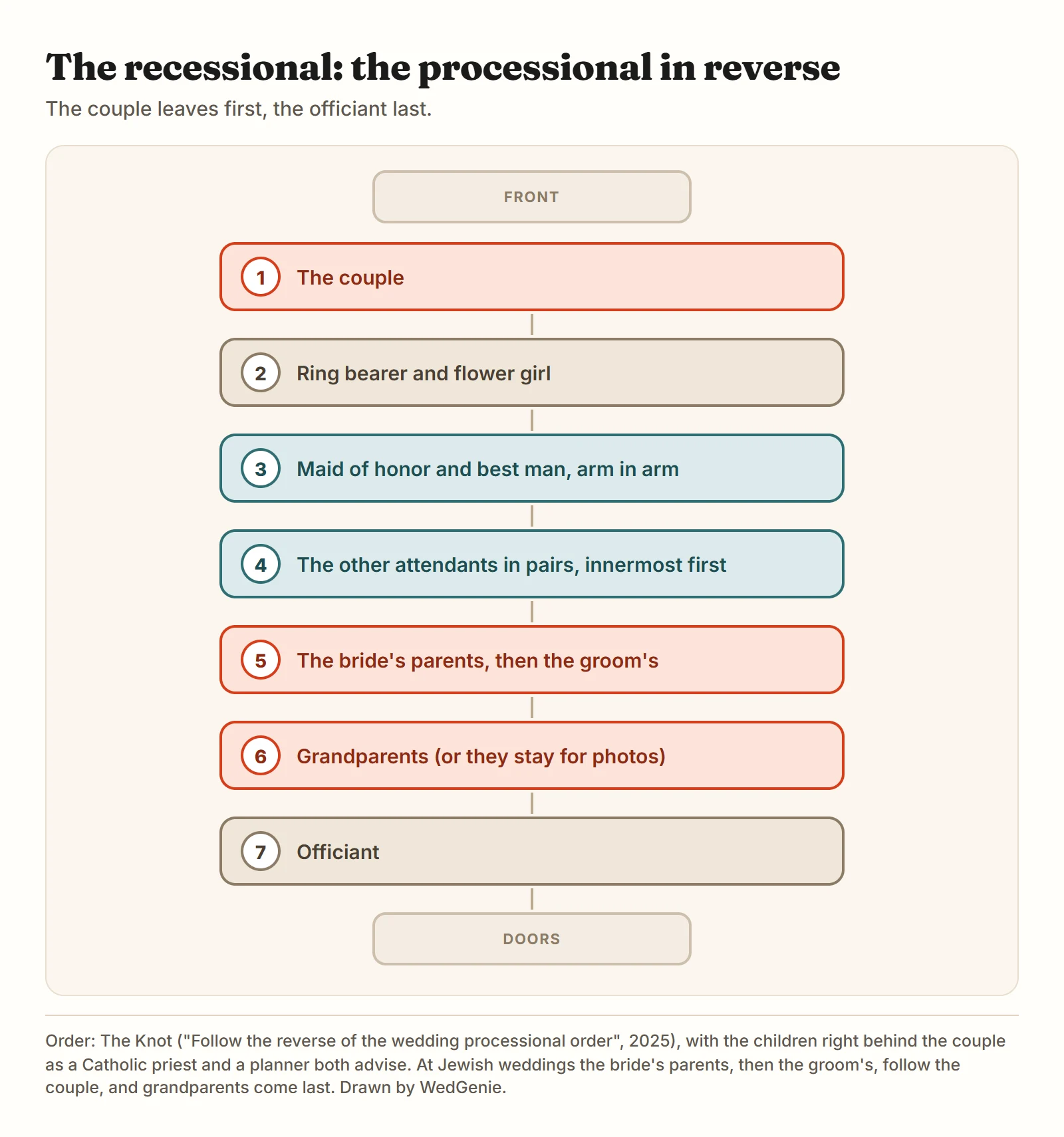
- The couple
- Ring bearer and flower girl, right behind the couple, as a Catholic priest advises in The Knot (its modern list leaves them out)
- Maid of honor and best man, arm in arm
- The other attendants in pairs, "in order of how close they were standing to the couple" (The Knot)
- The bride's parents, then the groom's
- Grandparents, or they stay for photos at the front
- The officiant
At a Jewish wedding, Rabbi Stacy Bergman describes the couple recessing together, "usually the bride's parents first, then the groom's parents," then the wedding party in pairs or threes, then grandparents and others, before about "20-ish minutes of Yichud." A Catholic couple may slip away after the recessional to sign the marriage license with their witnesses.
One lineup, worked through
Here is the whole thing for one fictional wedding, Nadia and Owen's (from our speech examples): a Christian ceremony, everyone walking the aisle.
| Order | Who | Ends up |
|---|---|---|
| 1 | The officiant | Center, facing the guests |
| 2 | Owen | Front, guests' right |
| 3 | Both sets of grandparents | Front rows, each on their grandchild's side |
| 4 | Grace and David, Owen's parents | Front row, right |
| 5 | Helen, Nadia's mother, escorted by her daughter Leila | Front row, left |
| 6 | Ana and Ben | Outermost, splitting left and right |
| 7 | Marisol and Mateo | Next in |
| 8 | Jo and Theo | Next in |
| 9 | Raf, best man | Beside Owen |
| 10 | Tess, maid of honor | Beside Nadia |
| 11 | Leo (8, decoy rings; Raf holds the real ones) and Ivy (6, petals) | Then row two with their parents |
| 12 | Guests stand; Nadia with her father, Paul | Paul sits beside Helen |
The recessional reverses it: Nadia and Owen, Leo and Ivy, Tess and Raf, Jo and Theo, Marisol and Mateo, Ana and Ben, Helen and Paul, Grace and David, the grandparents (or they stay for photos), the officiant. Twelve entrances fit in about five minutes; The Knot's planners say a processional "will take no more than five minutes."
Where the processional sits in the ceremony
The processional opens the ceremony and the recessional closes it; everything else, from the readings to the vows, happens between them. The speeches are a separate order, at the reception: see the wedding speech order. Other traditions differ more: a Hindu baraat brings the groom "accompanied by his family and friends on horseback, by elephant or in a special vehicle," and can take an hour, while at a Muslim Nikah, "Instead of a processional the way we might envision it, family members gather around each member of the couple" (The Knot).
Rehearse it once
Walk the recessional first, then the processional, a day or two before. Seat the parents, place the wedding party where they will stand, practise walking out, then walk in. WedGenie's free wedding checklist schedules the ceremony rehearsal one to two days before the wedding, the one time the whole wedding party walks the processional and recessional before the day.
Questions about the processional
Who walks down the aisle first?
The officiant is at the front first, either walking in or entering from the side. After that it depends on the guide: grandparents and parents, or straight to the groom and the attendants.
What is the Jewish processional order?
Rabbi and/or cantor, grandparents, groomsmen, best man, the groom with both parents, bridesmaids, maid of honor, children, and the bride with both parents. The groom must arrive first; the rest is custom.
What is the Catholic processional order?
Priest, groom and best man from a side door; the groom's parents; the mother of the bride; the attendants in pairs; the maid of honor; the children; the bride with her father. The current rite says only "in the customary manner," so ask your parish.
Which side does the bride stand on?
On the left as the guests see it at a Christian wedding. At a Jewish wedding she stands at the groom's right hand, which is the guests' right if the couple faces the rabbi.
Does the maid of honor walk with the best man?
Either way. WeddingWire says she walks alone; The Knot's ceremony-order guide pairs them. In the recessional they usually leave together, arm in arm.
What is the recessional order?
The processional in reverse: the couple, the children, the maid of honor and best man, the other attendants in pairs, the parents, the grandparents and the officiant.
Who walks the groom down the aisle?
Traditionally no one: he walks alone or enters from the side. Some grooms walk with both parents, as every groom does at a Jewish wedding.
How long does the processional take?
Five minutes at most, according to The Knot's planners; a Hindu baraat can take an hour.
Do guests stand for the bride?
Customarily, yes, though The Knot says you can "go about that scenario however you please."