

The short version
- A day-of coordinator usually starts four to six weeks before the wedding, not on the day, which is why many planners now sell it as month-of coordination.
- Couples who hired help for a 2025 wedding paid $1,600 on average for a day-of coordinator and $3,800 for a full-service planner (The Knot). On a $30,000 wedding that $2,200 gap is about 16 guests' food and drink at US-average prices.
- A venue coordinator works for the venue. If you plan the wedding yourself, someone you hire or brief still has to run the day, and it shouldn't be you.
A day-of wedding coordinator takes the plan you built, confirms it with every vendor in the last few weeks, and runs the wedding day so you and your family don't have to. Despite the name, most start four to six weeks before the wedding. Couples who hired one for a 2025 wedding paid $1,600 on average, against $2,400 for a month-of coordinator and $3,800 for a full-service planner, according to The Knot's 2026 Real Weddings Study.
Coordinator prices online run from $764 to $3,500 and up, mostly because they measure different things: what couples paid, what vendors quote, what an editor estimates. Below, every number sits next to how it was measured, with three firms' own price lists and the math on a $30,000 wedding, tips included. WedGenie sells no leads to vendors and runs no sponsored listings, so nothing here depends on which kind of help you pick.
What does a day-of wedding coordinator do?
They take over your plan in the final weeks, confirm it with every vendor, and run the day so nobody you love has to. Jamie Chang of Mango Muse Events describes the job to The Knot as "a wedding professional who comes in towards the end of your planning to take over and help coordinate and execute the details of your wedding on your wedding day."
Before the day, that means calls and paperwork. "I reach out to each vendor to confirm arrival times, setup details and contact information," Maren Doernbrack told The Knot. On the day, it means letting vendors in, setting up, cueing the ceremony and keeping the reception moving: "There shouldn't ever be a lull where guests wonder what is supposed to happen next," says Nora Sheils of Bridal Bliss. Most weddings need more than one person on site; Chang puts it as "most require at least two."
One real package, to show what the money buys: Bridal Bliss's "Day Of Facilitation" in Seattle, Portland and Bend lists two pre-wedding consultations, "Constructing a detailed wedding day timeline," "Confirming all details with the appropriate vendors prior to the wedding," running the rehearsal, "Up to eight hours on-site with your lead coordinator and one assistant," handing out final payments and tips, and an emergency kit. "Pricing begins at $3,500."

When does a day-of coordinator start?
Most start four to six weeks before the wedding; the name is older than the job. Chang says "'day-of' is misleading since really, their work will begin thirty to 45 days before your big day," and Zola, Joy and coordinators' own packages give the same four to six weeks. Danielle Couick, also in The Knot, draws the line a little differently: month-of coordination "usually starts four to eight weeks from your wedding date," while a true day-of coordinator "might not step in until the week before."
Not everyone agrees. The Knot's own cost page says a day-of coordinator "doesn't help with any of the logistics before the celebration," which contradicts its day-of page. The label covers two different products, so get the start date and the hours in writing. As Couick warns, "Many planning companies offer "day-of coordinators" that are actually month-of coordinators, so read a wedding planner's contract and package descriptions carefully."
The start date matters because handing over a plan takes time. "It's really difficult for couples to pass their plans over if their coordinator isn't brought into the process beforehand," says Shelby Donald.

How much does a day-of coordinator cost?
Couples paid $1,600 on average in 2025, and published ranges run from about $700 to $3,000. The spread comes from method more than from market:
- What couples paid: The Knot's 2026 study of 10,474 couples married in 2025: day-of $1,600, month-of $2,400, full service $3,800. For any kind of planner the average was $2,100, from $1,700 at weddings of 50 or fewer guests to $2,300 above 100.
- What vendors list: Zola's figures come from its vendor price index ($800 to $3,000 for day-of in the body of both its planner pages).
- What one marketplace quotes: Thumbtack's "around $764" national average for day-of coordination comes from its own platform, which leans toward independent coordinators.
- What editors estimate: Joy's $800 to $2,500 and Fash's member-reported $700 to $2,200 (from 2023) carry no study behind them.
What each kind of help costs, by source
- Day-of · Fash (2023)$700–$2,200
- Day-of · Joy (2026)$800–$2,500
- Day-of · Zola (2026)$800–$3,000
- Partial · Zola (2026)$1,500–$6,000
- Partial · Joy (2026)$1,800–$4,500
- Partial · Fash (2023)$2,300–$3,800
- Full · Fash (2023)$2,500–$8,500
- Full · Zola, "most couples" (2026)$3,200–$4,900
- Full · Joy (2026)$3,500–$10,000+
Real firms price the tiers as a ladder, and the ladder is steeper than the averages suggest. These are starting prices as each firm lists them, read on October 18, 2026:
| Firm (where it lists prices) | Day-of or month-of | Partial | Full | Full ÷ day-of |
|---|---|---|---|---|
| The Final Touch, Chicago (The Knot) | $1,950 | $3,000 | $5,200 | 2.7 |
| Lumiére Aisle Collective, Aurora, Colorado (WeddingWire) | $850 | $1,500 | $2,300 | 2.7 |
| Magnolia Grove Weddings and Events, Wilson, North Carolina (via Thumbtack) | $1,200 (25 hours, month-of) | $1,600 (35 hours) | $2,750 (50 hours) | 2.3 |
| The Knot's averages, what couples paid | $1,600 | $3,800 | 2.4 |
Within one firm, full planning costs 2.3 to 2.7 times the day-of package. Magnolia Grove bills extra time at $45 an hour, which is the cost to ask about before you sign.
Day-of coordinator vs. wedding planner: what's the difference?
A planner builds the plan with you from the start; a coordinator runs the plan you built. A full-service planner books and manages your vendors for a year or more: Ashley Allan of Your Jubilee Weddings told The Knot that "full-service planning involves the company's lead planner spending 150–250 hours on a wedding, which is before the assistant staff's hours are added." A partial planner joins partway through, for roughly 20 to 80 hours (Fash). A coordinator joins near the end.
Among couples who hired help in 2025, 37% chose a day-of coordinator, 33% a full-service planner, 17% a month-of coordinator and 4% a destination coordinator (The Knot). Those are shares of couples who hired a planner, not of all couples; nobody has published a current figure for how many hire one at all. The last we found is WeddingWire's for 2019 weddings: "30% hire a planner for some or all of the wedding logistics."
What the choice costs on a $30,000 wedding
At average prices a day-of coordinator costs $2,200 less than a full-service planner, before tips. The Knot's tipping guide says "15–20% of the total fee is the standard recommendation for how much to tip a wedding planner" and "Tip your wedding coordinator $50–$150"; Fash adds that coordinators who run their own business "do not expect a tip."
| Help | Fee | Tip | All in | Share of $30,000 |
|---|---|---|---|---|
| Full-service planner | $3,800 average | 15–20%: $570–$760 | $4,370–$4,560 | 14.6–15.2% |
| Full-service, priced as a share | 10–20% of the budget (Zola) | $3,000–$6,000 | 10–20% | |
| Month-of coordinator | $2,400 average | $50–$150 | $2,450–$2,550 | 8.2–8.5% |
| Day-of coordinator | $1,600 average | $50–$150 | $1,650–$1,750 | 5.5–5.8% |
| Venue coordinator plus a friend with your folder | Included / $0 | A thank-you gift | About $0 | 0% |
WedGenie's free wedding budget calculator sets aside 4% for the planner, the officiant and extras: $1,200 on a $30,000 wedding. That covers The Knot's $260 average officiant and leaves $940. A day-of coordinator runs $710–$810 past it, which the $1,500 buffer can absorb. A full-service planner runs $3,430–$3,620 past it, more than the whole buffer, so it has to come out of another line.
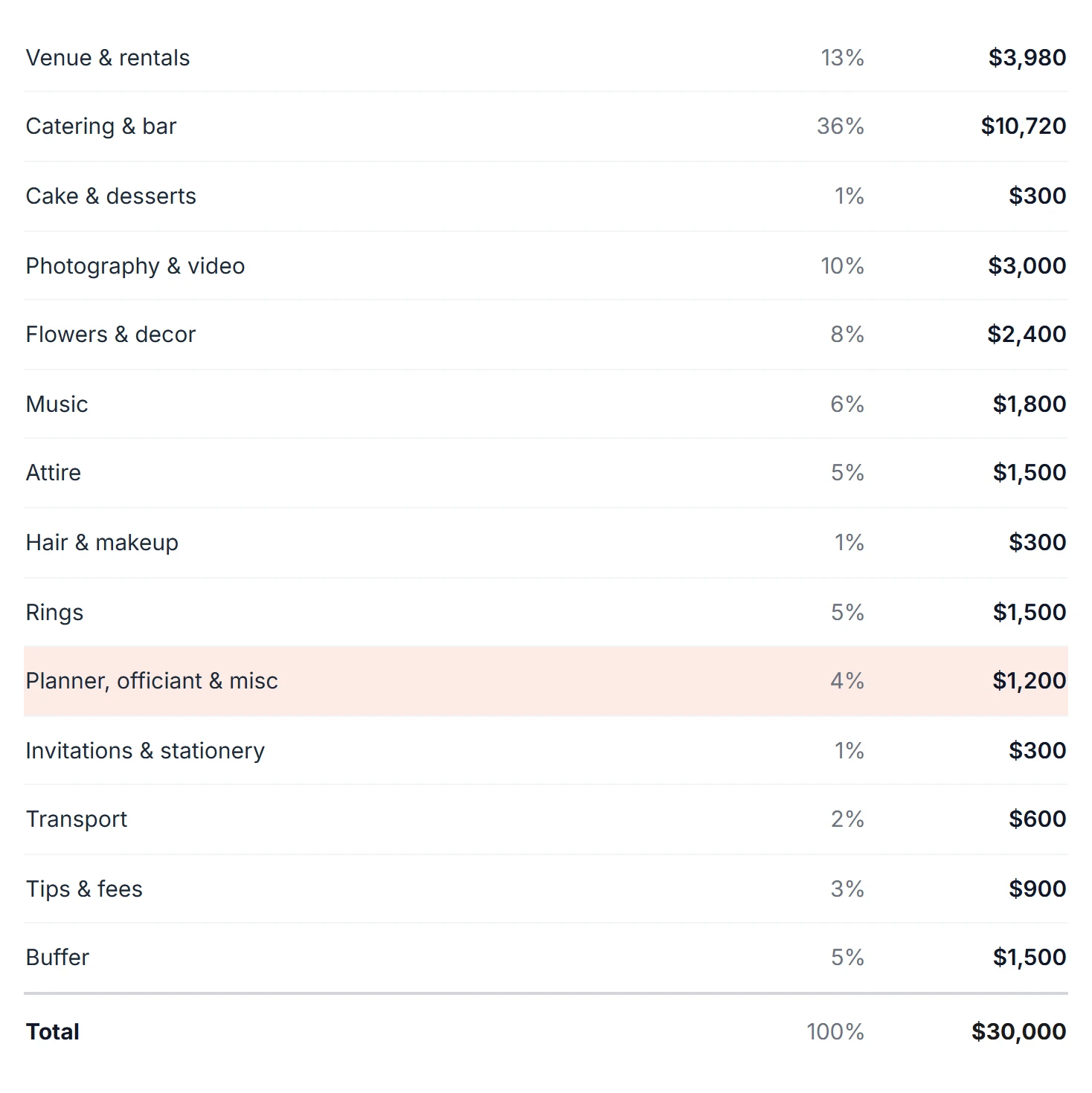
The $2,200 gap is about 16 guests' food and drink at the US-average $134 a head the calculator uses, or 25 with a buffet and beer and wine. Two costs people forget: the coordinator's meal ("Your catering budget should include meals and beverages for the coordinator and any assistants," Fash), and hours past the package.
The saving comes from the choice of help, not from software. What you take back by skipping the planner is their 150 to 250 hours, which become yours: couples already spend about 7 hours a week on planning (The Knot). WedGenie's free checklist and budget tools are built for couples doing that work themselves.
Do you need a wedding planner?
Not always: a planner pays off when you're short on time, marrying far away, using a blank-canvas venue or inviting 150 or more. That is Zola's rule almost word for word: "Hire a planner if you're short on time, planning a destination wedding, working with a blank-canvas venue, or managing a guest list over 150." The other side: "Skip full-service if you're organized, have a simple wedding under 100 guests."
The Knot, whose marketplace lists planners, answers the question with "The short answer is yes." Its own study is more useful: one partner does "roughly 64% of tasks," and couples average 7 hours a week over a 14-month engagement. If you can't find that time, buy it. If you can, the planning timeline shows what to do when, and the one thing nearly everyone agrees on is the coordinator: "A day-of coordinator is almost always worth it" (Zola), and "if a couple decides to plan their wedding themselves, it's essential they hire a day-of coordinator to manage vendors, setup, the timeline and so on" (Tonya Hoopes, in The Knot).
Is the venue coordinator enough?
Usually not: a venue coordinator works for the venue, not for you. "Their job is to make sure the venue runs smoothly — not to manage your other vendors or handle personal logistics," Zola writes, though "they do handle a lot of on-site logistics." Fash is blunter: "A venue coordinator's primary job is to protect the venue and ensure events stay on schedule," and they typically don't contact your vendors before the day. Some venues go further: "Some venues require a day-of wedding coordinator in addition to their on-site venue coordinator," and some keep a list of approved coordinators you must choose from.
Five questions settle it with your venue:
- Who from the venue is on site on the day, and until what time?
- Do they cue the ceremony and the reception moments, or only the room?
- Do they contact my outside vendors before the day?
- Who sets up and packs away my own decor?
- Do you require a coordinator, or keep a list of approved ones?
More for the venue tour are in questions to ask a wedding venue.
Can a friend be your day-of coordinator?
Yes, if you hand them the folder and accept they'll spend your wedding working. Zola's advice: "Give them a detailed binder with your timeline, vendor contacts, floor plans, and a list of who to call if something goes wrong. It's not the same as a professional, but it's far better than handling it yourself on the day." Joy calls it "a significant ask," and it is: your friend misses the parts of the day they came for.
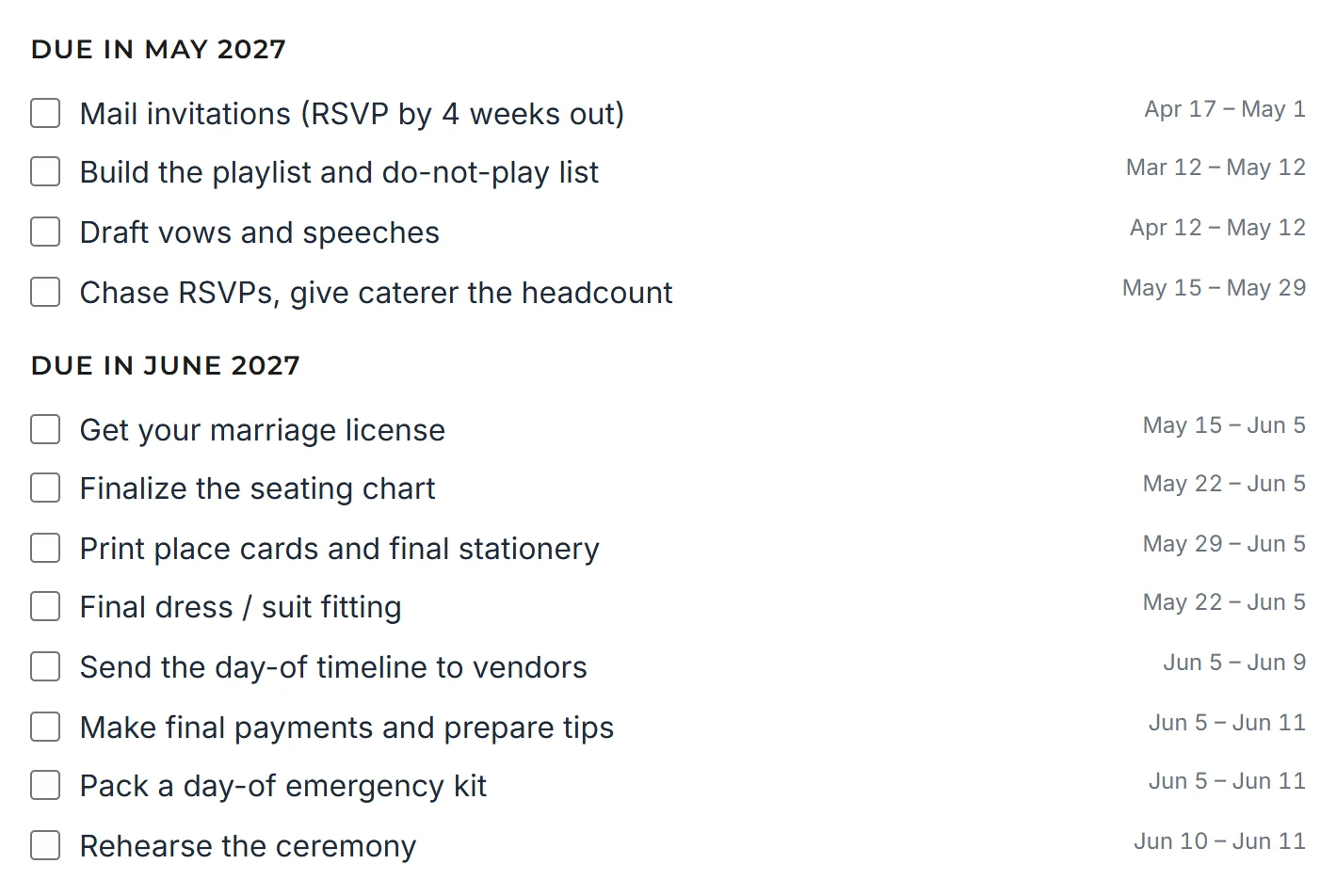
The folder is the same whoever carries it. WedGenie's checklist generator dates every final task from your wedding day and ends with a day-of coordinator section listing what goes in it.
Gabby Pinkerton, a Nashville planner, filmed one such wedding from the coordinator's side: the couple "did all their own planning and design and our team came in for Wedding Management (aka Month of Coordination)."
Questions to ask before you hire one
Ask when they start, how many hours they're on site, and who actually shows up. Shelby Donald's list for The Knot, plus three from Joy:
- "Do you provide any planning support before one month out?"
- "How many hours of coordination do you include?"
- "Do you have a broader team?"
- "Do you manage the setup and teardown of our personal decor, and if so, what setup isn't included?"
- "How many weddings have you and/or your team coordinated?"
- "How do you approach collaborating with other wedding vendors?"
- "Do you offer planning services we can upgrade to if we need more support?"
- "Will you personally be at my wedding, or will it be an associate?"
- "When do you actually start working with me — not just "day of"?"
- "Do you have an assistant or backup if something happens to you?"
Then watch how fast they answer: 52% of couples in The Knot's 2026 study named responsiveness a top reason for choosing a planner, ahead of reviews and years in business.

Questions about day-of coordinators
What's the difference between day-of and month-of coordination?
Mostly the start date and the price. Month-of coordinators start four to eight weeks out and averaged $2,400 in 2025; day-of coordinators start a few weeks out or the week of and averaged $1,600. Many firms sell the same package under both names, so compare start dates and hours, not titles.
How far ahead should you book a day-of coordinator?
Zola suggests six to eight months before the wedding; a full-service planner is best booked in the first month or two of the engagement.
How many hours does a day-of coordinator work?
Typically 25 to 40 hours in all, by Loverly's estimate, with six to ten of them on site on the day, depending on the package.
Do I need a day-of coordinator if my venue has one?
Usually yes. The venue coordinator runs the venue; your coordinator runs your vendors, your timeline and your family's day.
How much do you tip a day-of coordinator?
The Knot suggests $50 to $150 for a coordinator and 15 to 20% of the fee for a planner. A coordinator who owns the business may not expect a tip at all (Fash).
Is a day-of coordinator worth it for a small wedding?
Often, yes: Zola puts day-of help in the "almost always worth it" column even when it says to skip full service for simple weddings under 100 guests. The Knot's couples with 50 or fewer guests paid $1,700 on average for any kind of planner.
How much does a full-service wedding planner cost?
$3,800 on average for 2025 weddings (The Knot). Zola's index puts most couples between $3,200 and $4,900; planners who charge a share of the budget usually take 10 to 20%.
Can WedGenie be my day-of coordinator?
No. Nobody from WedGenie attends in person: it's software. On the Pro plan ($14.99 a month or $99 a year, up to 200 messages a day), the Genie answers from your plan on the day: a florist running late, a table of eight that just became five, a message to send your venue. Couples running a full-scale day often pair it with a human coordinator who runs the room.