

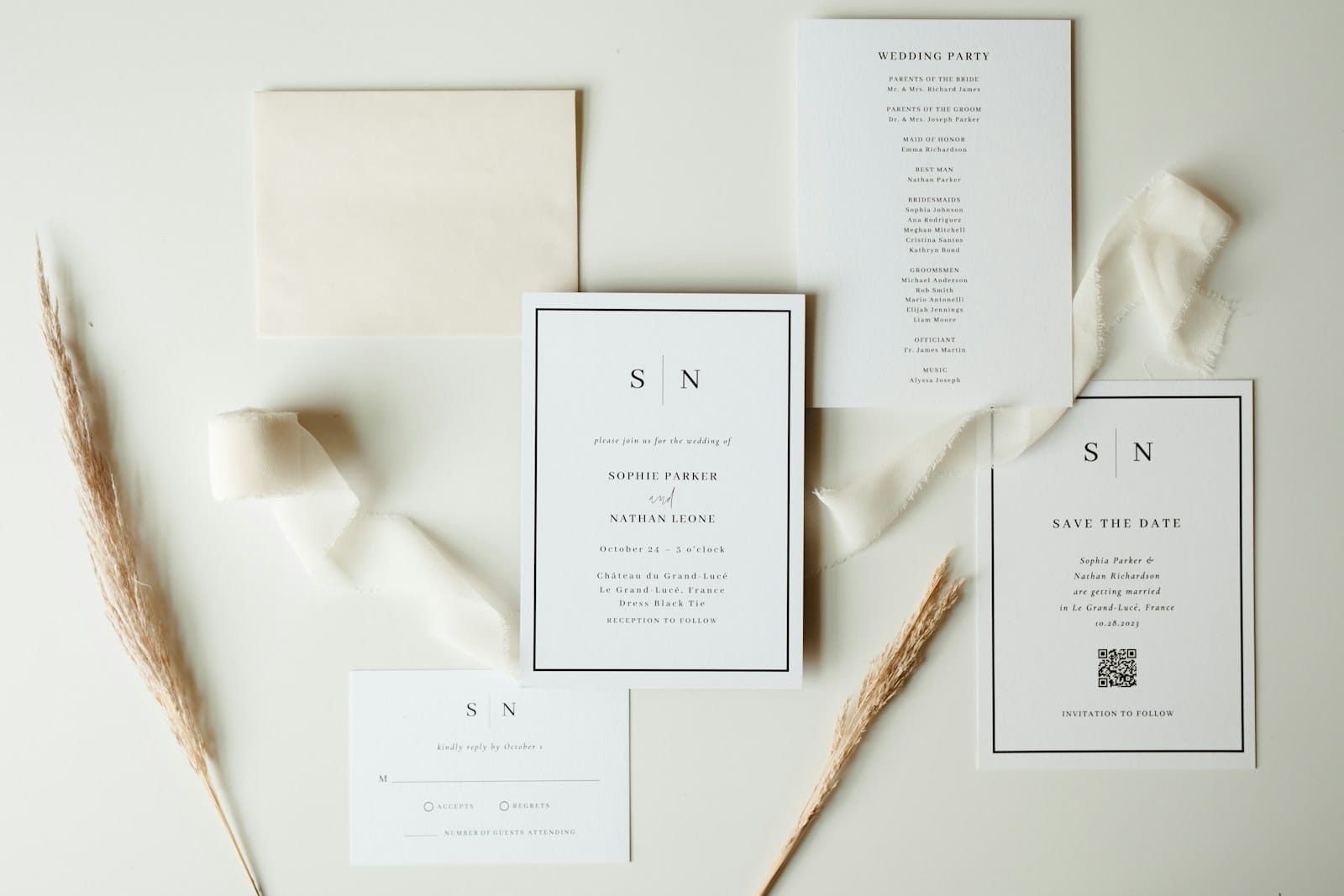
The short version
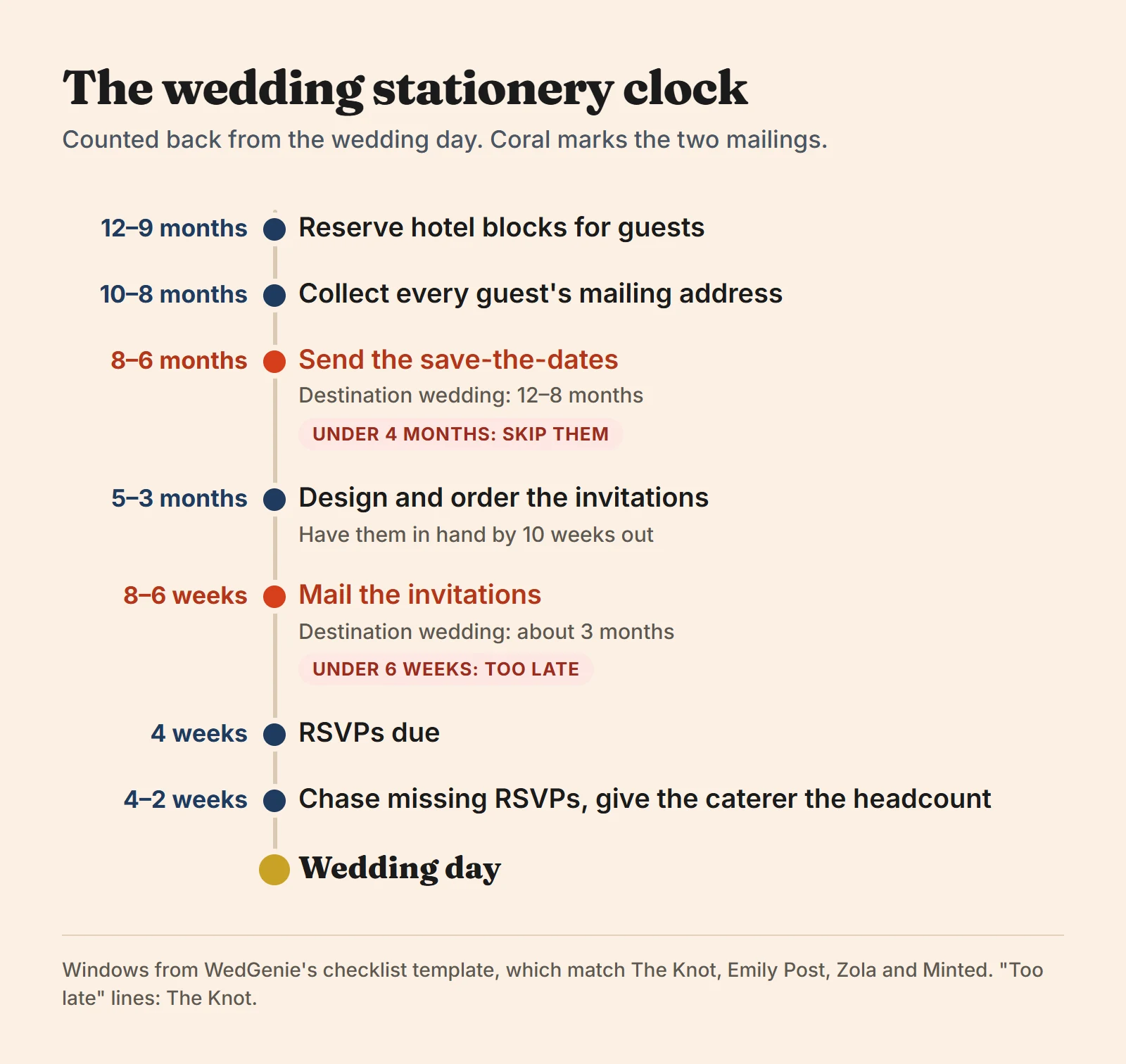
- Mail invitations six to eight weeks before the wedding and set the RSVP deadline about four weeks out; The Knot calls anything after six weeks too late.
- Send save-the-dates six to eight months out, or 8 to 12 months for a destination wedding, and order the invitations by about three months out.
- A square envelope costs $1.31 to mail at one ounce under USPS's July 2026 prices: the 82-cent stamp plus a 49-cent nonmachinable surcharge.
Prefer to watch? The 3-minute explainer
Wedding Planning Checklist by Your Wedding Date
Read the transcript
The short answer 0:00
What should you do for your wedding, and when? Here's the short version, counted back from your date. Book the venue about a year out. Order the dress 8 to 10 months out. Mail the invitations 6 to 8 weeks out. And get the marriage license in the last 4 weeks. Everything else on the list fits around those four. This is the wedding planning checklist behind WedGenie's free generator.
Windows, not dates 0:26
Where do those numbers come from? From the guides most couples use: The Knot, Zola, WeddingWire and Emily Post. They don't agree to the month, so instead of one date, every task gets a window: start any time after the first date, and finish by the second. And you probably have more time than you think. The Knot's 2026 study puts the average engagement at 14 months.
Your month sets the venue deadline 0:51
The first deadline depends on your wedding month. 76% of couples marry between May and October, and the busiest months go first. Zola says to book the venue 12 to 14 months ahead for June, September or October, 9 to 12 for May, July or August, and just 3 to 6 months for January to March. Then book your photographer, because most photographers shoot one wedding a day.
The dress takes longest 1:18
The longest lead time on the list is the dress. A made-to-order gown takes 16 to 20 weeks to arrive, and then 8 to 12 weeks of alterations. That's why The Knot says to order it 8 to 10 months out. Under 6 months, look at off-the-rack and sample dresses instead. Suits are quicker: rentals book 2 to 3 months ahead.
The mail clock 1:41
Then there's the mail. Save-the-dates go out 6 to 8 months before the wedding, with your website on them. Invitations go out 6 to 8 weeks before, with RSVPs due 3 to 4 weeks out. The Knot is blunt: any time after 6 weeks is too late. And if your envelopes are square, budget $1.31 each: an 82¢ stamp, plus a 49¢ surcharge.
The license is a window 2:06
The last deadline is legal. A marriage license is a window, not a date. Texas makes you wait 72 hours after it's issued. In Michigan, the license expires 33 days after you apply, and in Hawaii, 30 days after it's issued. So apply in the last 4 weeks, and never in the final few days.
Starting late 2:28
Starting late is normal. Our example couple, Sofia and Jake, are getting married on May 8, 2027, and they started planning in October, 7 months out. When they enter their date, every task that's past its deadline lands in one catch-up list, in the order it was due, venue first. They work it from the top, and everything after that has its own window.
Get your dated list, free 2:52
To get your own dated list, use WedGenie's free wedding checklist generator. Enter your date, and every task gets a start date and a due date. Download it as a PDF or a spreadsheet, no sign-up needed. Or let the Genie keep it on your Wedding Board, and tick things off as you book. The link is in the description. It's free at wedgenie.ai, the AI wedding planner.
Narration is an AI voice; the example couple is illustrative. Watch on YouTube
Mail your wedding invitations six to eight weeks before the wedding and ask for RSVPs four weeks before it. Save-the-dates go out six to eight months ahead, or eight to twelve for a destination wedding, and the invitations should be ordered about three months out. The Knot, Emily Post, Minted and Shutterfly agree on all four numbers, so you can plan around them with confidence.
What those guides don't give you is the calendar for your own date, what postage costs this month, or how to address the guests who don't fit the textbook examples. That is what the rest of this guide is for.
When to send wedding invitations
Mail them six to eight weeks before the wedding. Earlier than about twelve weeks, your guests' plans aren't settled yet; later than six weeks, you squeeze their travel plans and your own RSVP deadline. The Knot puts it bluntly: "Any time after six weeks is, by etiquette and practicality standards, too late to send wedding invitations." Emily Post, Minted and Shutterfly give the same six-to-eight-week window.
Which end of it? If guests reply on paper cards, aim for eight weeks, because the cards have to travel both ways. If they reply online, six weeks is enough.
These are US conventions. Some Australian guides ask for three to four months, so don't let an overseas article unsettle you.
If you didn't send save-the-dates
Mail the invitations eight to twelve weeks out instead. The invitation is now the first notice, so guests need longer to book time off and travel. Minted says 8 to 12 weeks; Shutterfly says 10 to 12.
Destination weddings
Send the invitations about three months ahead. The guides spread out more here than anywhere else: one of The Knot's pages says eight weeks, another says "10 or 12 weeks", and a planner The Knot quotes prefers four to six months. Minted says about 12 weeks and Shutterfly three to four months. Three months sits in the middle and leaves time for flights and passports.
Guests who live abroad
Mail theirs eight to twelve weeks out, ahead of everyone else's. The Knot suggests nine to ten weeks; Minted goes to twelve when many guests are flying in. USPS offers no tracking on international letters, so send them early enough to follow up by email if one goes quiet.
Holiday weekends and weekday weddings
Lean early. For a holiday wedding The Knot suggests eight weeks and says you "can inch closer to three months"; Shutterfly says at least 12 weeks for holidays and 8 to 10 for a weekday wedding.
Paperless invitations
Same schedule. In The Knot's words: "If you're going paperless, you should still keep with the traditional six-to-eight-week wedding invitation timeline."
When to send save-the-dates
Send them six to eight months before the wedding, or eight to twelve months for a destination wedding. The Knot recommends "six to eight months ahead of the ceremony" and says that "under four months out from the wedding is considered too late for save-the-dates to make sense". At that point, skip them and send the invitations early.
Send one to everyone who will get an invitation, and to nobody else: a save-the-date is a promise that an invitation is coming. Put your wedding website on it, so guests can find the hotel block and travel details without texting you.
Expect to see other numbers. Zola gives three different windows on three of its own pages (4 to 6, 6 to 8 and 7 to 10 months), Minted says 6 to 9 and Shutterfly 6 to 12. Six to eight months is where they all overlap.
When RSVPs should be due
Set the deadline about four weeks before the wedding. The Knot's shortcut is to "subtract four weeks from your wedding date", and it says no later than two weeks out, ever. Zola says you should know your numbers at least three weeks before the day.
Four weeks is not padding. You will spend the week after the deadline chasing the guests who didn't reply (The Knot suggests waiting about a week before you follow up), and your caterer needs a final headcount around two weeks out.
When to order the invitations
Start the design about five months out and place the order by three months. The Knot recommends ordering "around 12–14 weeks ahead of your wedding" and having the invitations "with you and ready to mail at least 10 weeks before the wedding." Big online printers are quick (Minted quotes 4 to 7 business days for standard shipping), but custom printers can take up to four weeks, and you still need an evening or two to assemble, address and weigh everything.
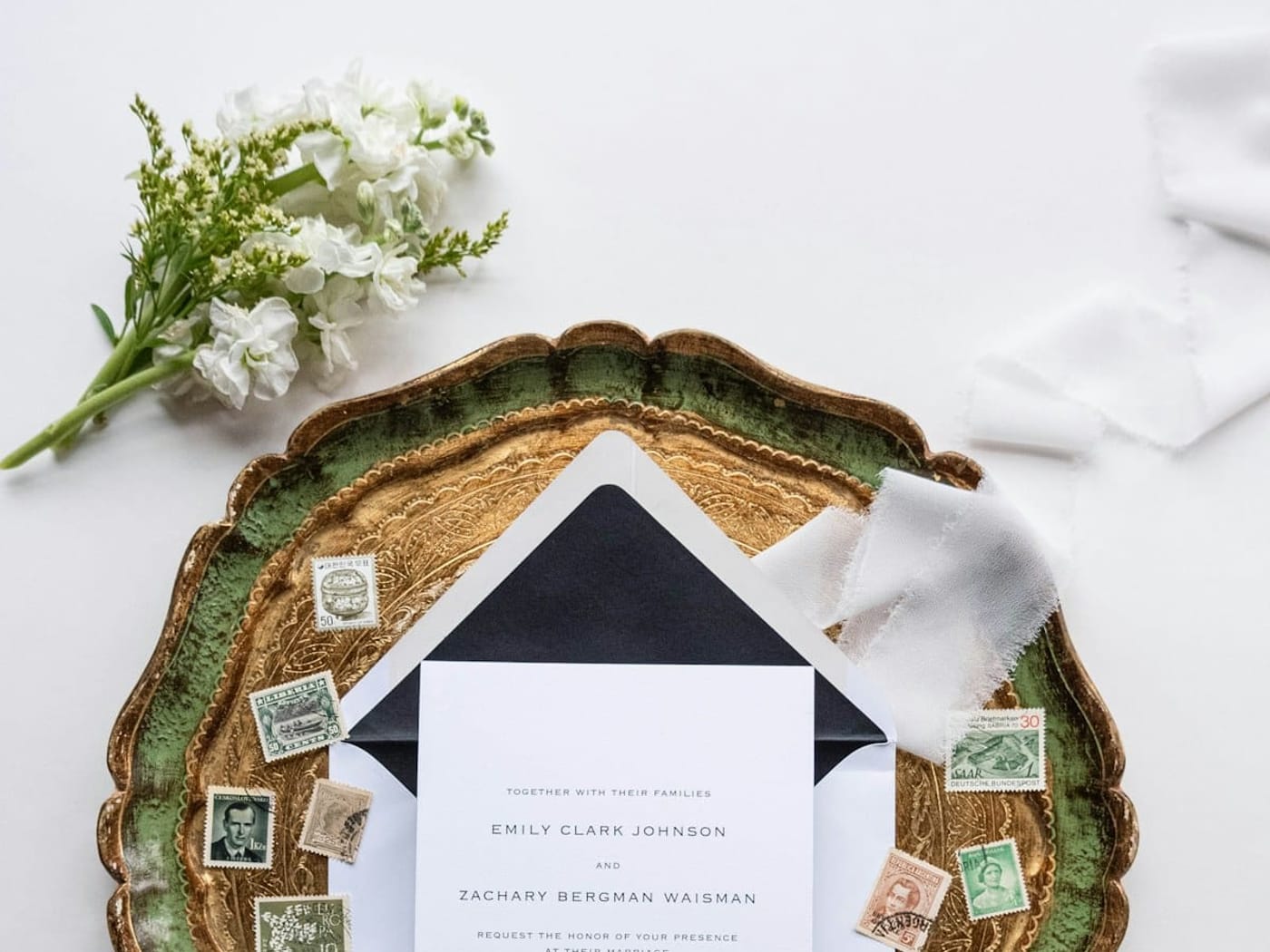
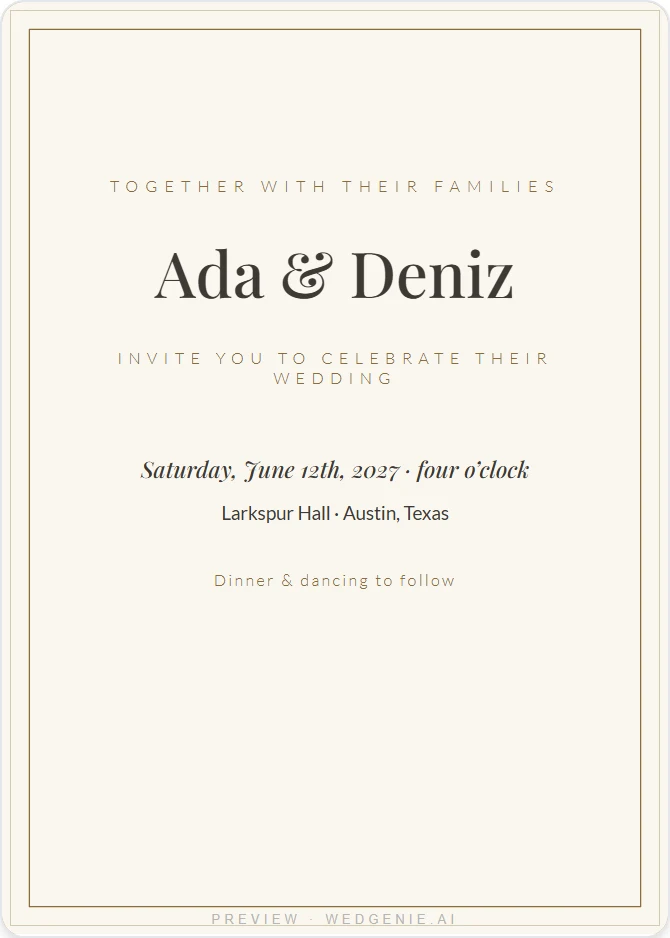
What to write on the invitation is its own subject, covered line by line in wedding invitation wording. To see your wording set in real type before you order, our invitation maker previews your names, date and venue live on five free templates.
Your dates, worked out
If your wedding is on June 12, 2027, the save-the-dates go out between October 12 and December 12, 2026, the invitations are ordered by March 12, mailed between April 17 and May 1, and RSVPs are due May 15. Here is the same calculation for six Saturdays in 2027, done by the same code that runs WedGenie's checklist generator:
| Wedding | Send save-the-dates | Order invitations by | Mail invitations | RSVPs due |
|---|---|---|---|---|
| Mar 13, 2027 | Jul 13 – Sep 13, 2026 | Dec 13, 2026 | Jan 16 – Jan 30, 2027 | Feb 13, 2027 |
| May 8, 2027 | Sep 8 – Nov 8, 2026 | Feb 8, 2027 | Mar 13 – Mar 27, 2027 | Apr 10, 2027 |
| Jun 12, 2027 | Oct 12 – Dec 12, 2026 | Mar 12, 2027 | Apr 17 – May 1, 2027 | May 15, 2027 |
| Sep 18, 2027 | Jan 18 – Mar 18, 2027 | Jun 18, 2027 | Jul 24 – Aug 7, 2027 | Aug 21, 2027 |
| Oct 9, 2027 | Feb 9 – Apr 9, 2027 | Jul 9, 2027 | Aug 14 – Aug 28, 2027 | Sep 11, 2027 |
| Dec 11, 2027 | Apr 11 – Jun 11, 2027 | Sep 11, 2027 | Oct 16 – Oct 30, 2027 | Nov 13, 2027 |
WedGenie's free checklist generator counts back from your wedding date and gives every stationery task a start date and a due date: save-the-dates, ordering the invitations and mailing them, with RSVPs due four weeks out. It runs in your browser, needs no account, and downloads as a PDF or a spreadsheet.
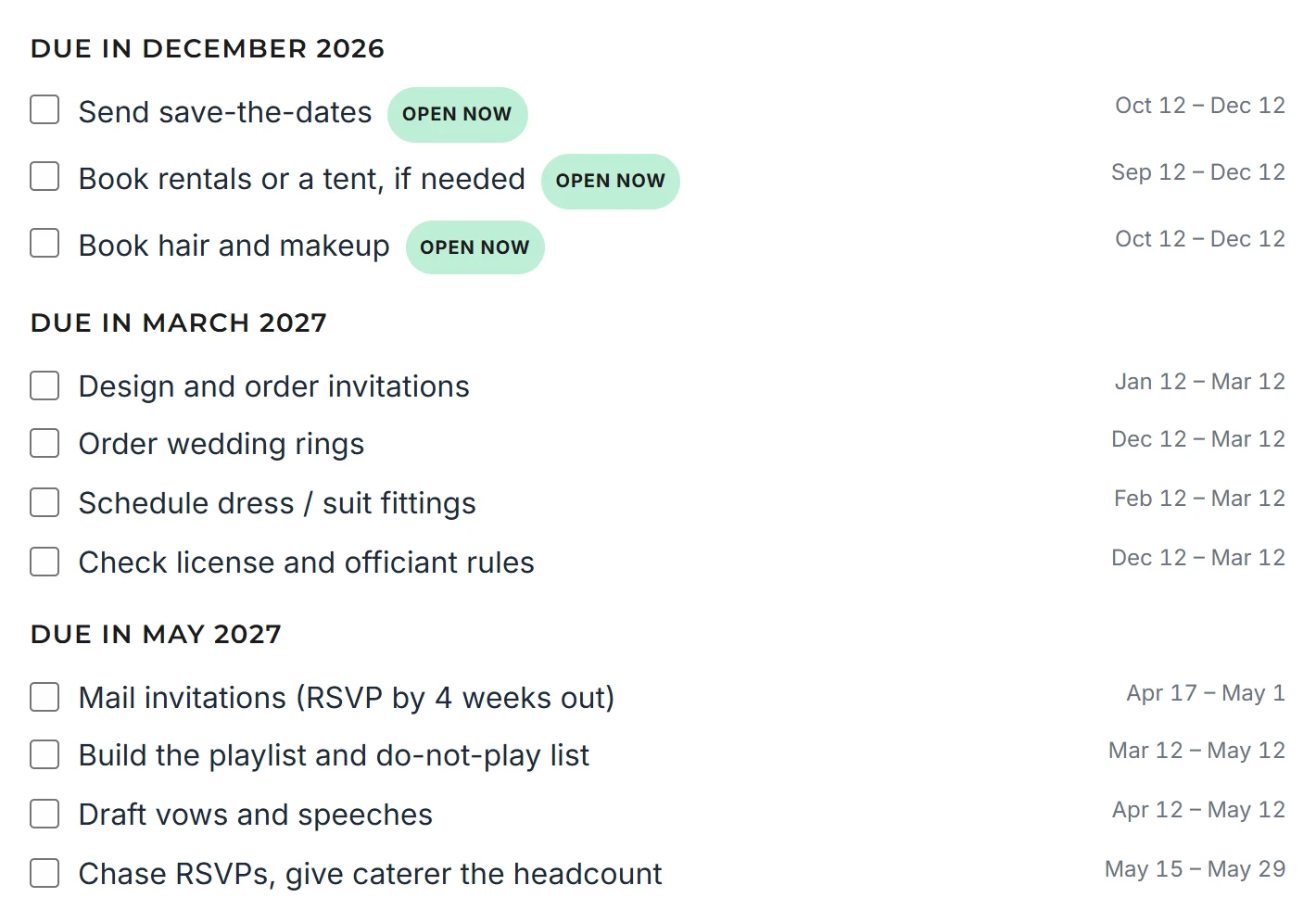
Two things to know about the generator. It uses the windows for a local wedding, so for a destination wedding move the save-the-dates to 8 to 12 months and the invitations to about three months yourself. And when a window has already closed, it shows the task under "Catch up now" instead of hiding it.
Starting late? If your wedding is less than six months away and nothing has gone out yet, skip the save-the-dates (under four months they no longer make sense) and send the invitations at the early edge, about three months out. The invitation then does both jobs.
What it costs to mail them
Weigh one finished invitation before you buy stamps. A standard 1-ounce envelope takes one 82-cent Forever stamp, each extra ounce adds 29 cents, and a square envelope, or one addressed vertically, adds a 49-cent surcharge. These are USPS's prices since July 12, 2026, from its current price list:
| What you mail | Standard envelope | Square or vertical envelope |
|---|---|---|
| Letter, 1 ounce | $0.82 | $1.31 |
| Letter, 2 ounces | $1.11 | $1.60 |
| Letter, 3 ounces | $1.40 | $1.89 |
| Postcard, up to 4¼ × 6 inches | $0.65 | n/a |
| Letter to another country, 1 ounce | $1.75 | $2.24 |
Three traps catch couples here:
- A 5×7 postcard save-the-date doesn't get the postcard price. That price stops at 4¼ by 6 inches (USPS DMM 101), so a 5×7 card pays the 82-cent letter rate.
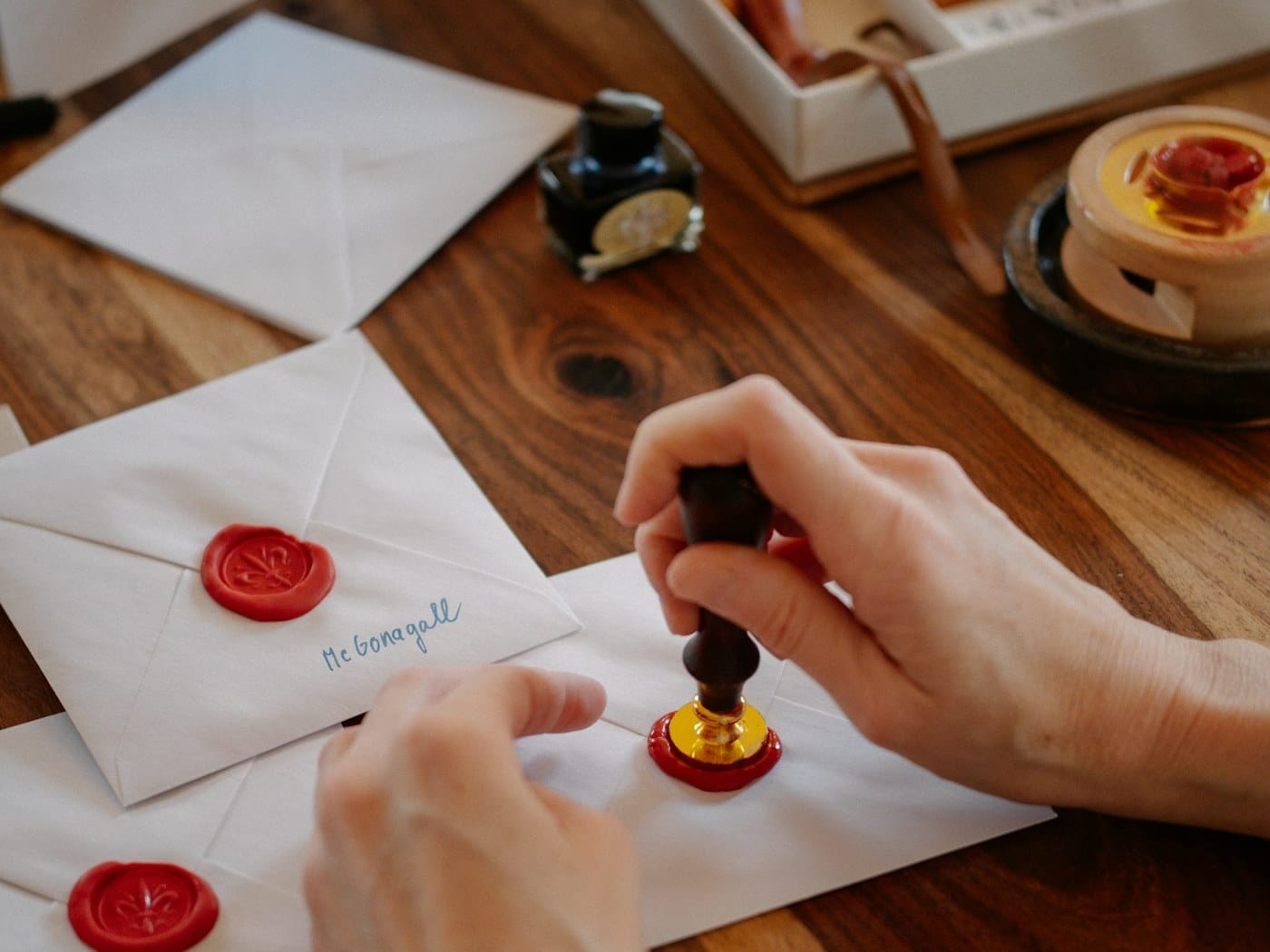
- The surcharge isn't only for squares. USPS also charges it for envelopes that are too rigid, uneven in thickness or closed with clasps or strings. A wax seal or a tied ribbon can tip an invitation over.
- Shape depends on how you address it. USPS: "You'll also have to pay more if your envelopes are square or vertical (taller than they are wide)." The standard A7 envelope for a 5×7 card is 5¼ by 7¼ inches. Addressed along the long side, it mails at the letter price; addressed along the short side, it counts as vertical and pays 49 cents more.

Many couples ask the post office counter to hand-cancel their invitations, so the sorting machines don't smudge the envelopes. That is a request you make at the counter, separate from the surcharge, which depends only on the envelope's shape, stiffness and thickness. USPS usually changes prices in January and July, so check the price list again if you mail after a change.
How to address wedding invitations
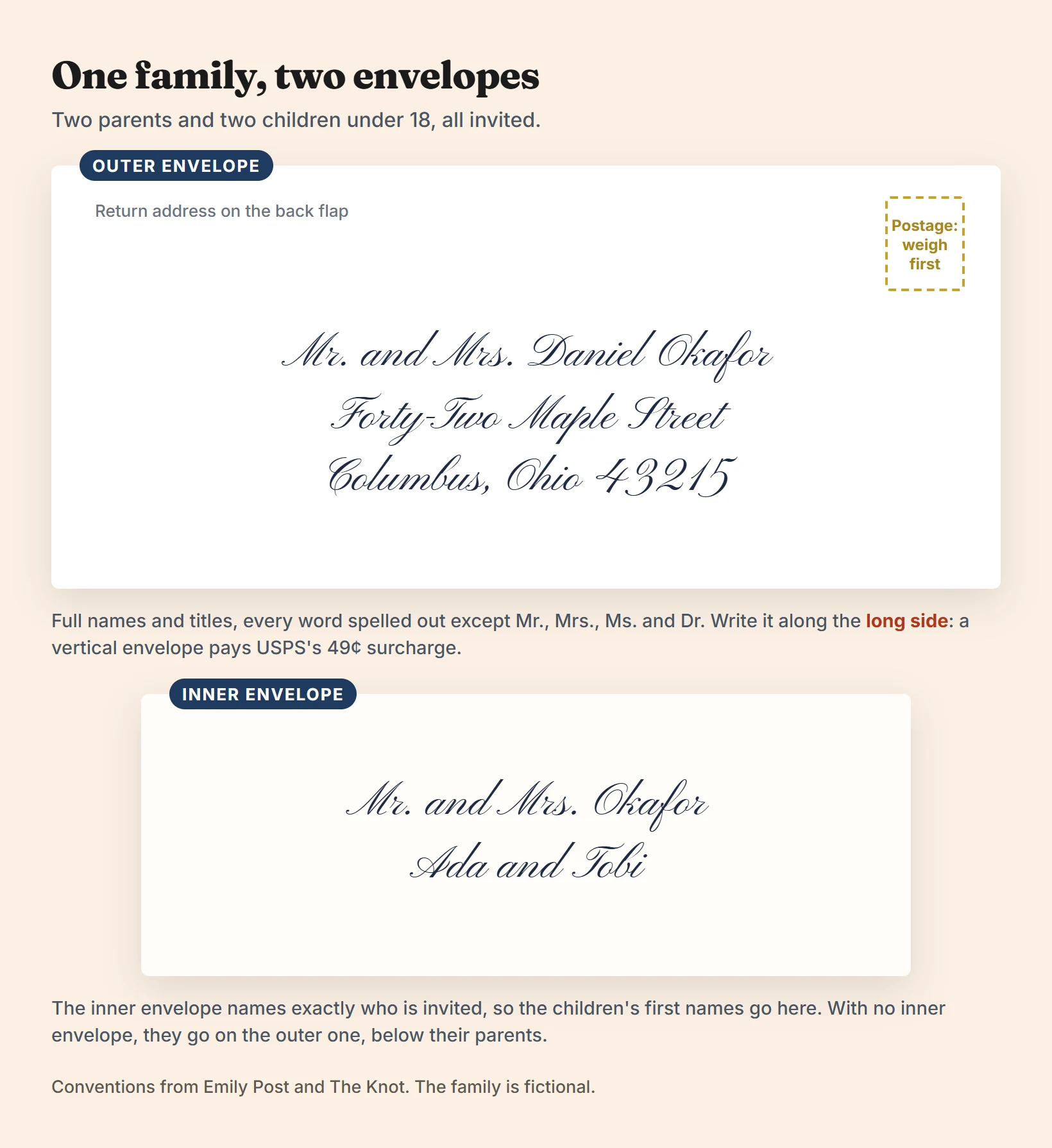
Write full names with titles on the outer envelope, spell out every word except Mr., Mrs., Ms. and Dr., and use the inner envelope, if you have one, to say exactly who is invited. Emily Post explains why the inner envelope exists: it "bears the title and last names of the specific people invited. This allows the host to be very clear about who is invited, and by omission, who is not invited."
No middle initials and no abbreviations: "Street", "Avenue" and numbered streets ("Sixty-Seventh Street") are written out. Your return address goes on the back flap.
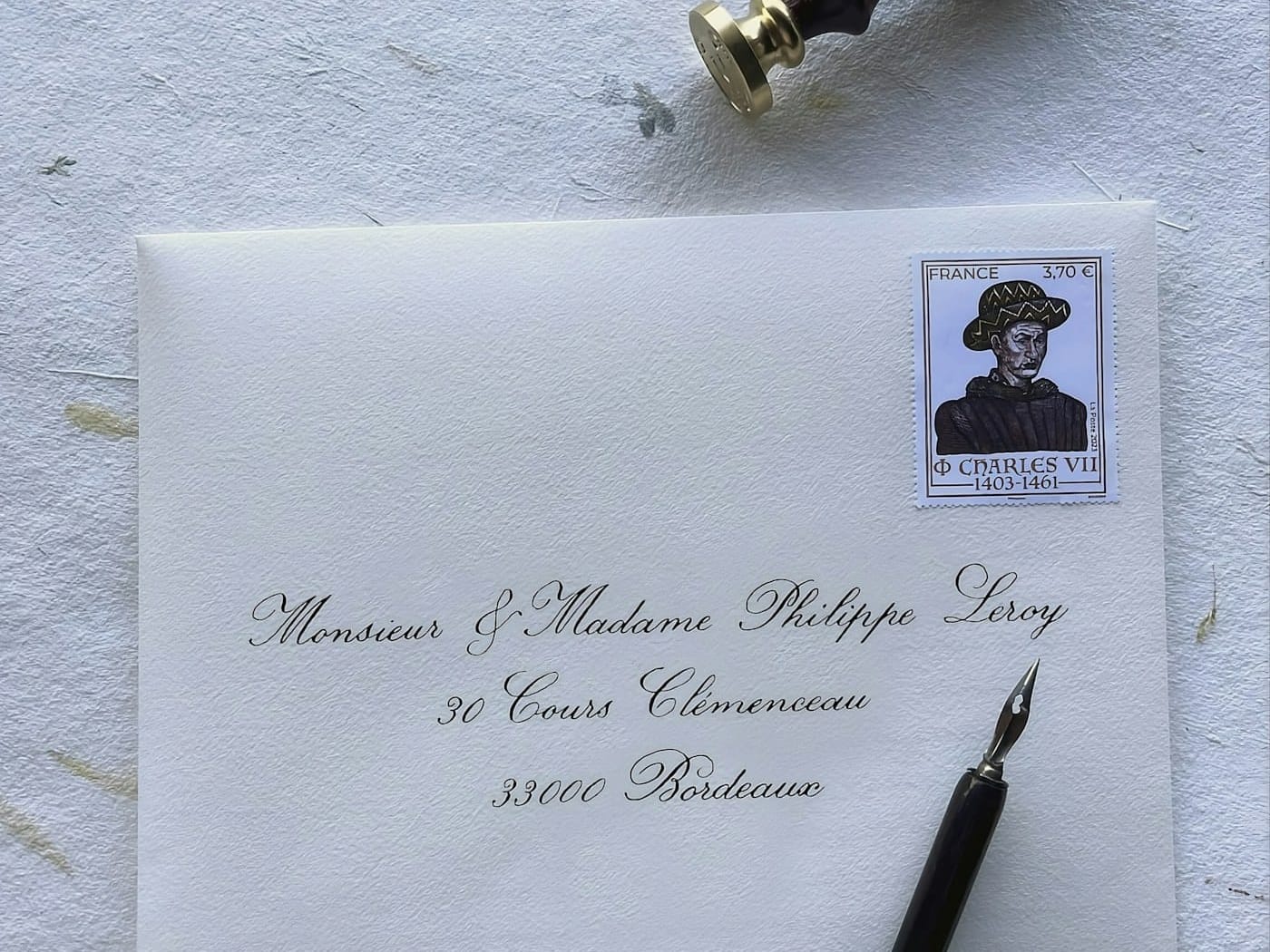
Handwritten or printed? Emily Post says to address every envelope by hand and never to use labels. The Knot says handwriting is "a nice touch, but it's not necessary," and most online printers will print your guests' addresses directly on the envelopes. Printed is fine; labels are the one option the strictest guide rules out.
Addressing examples for every guest
Married couples share a line, a guest with a professional title goes first, children under 18 go on the inner envelope, and anyone 18 or older gets their own invitation. The names below are fictional; the formats come from Emily Post and The Knot.
| Guest | Outer envelope | Inner envelope |
|---|---|---|
| Married couple, same last name | Mr. and Mrs. Daniel Okafor | Mr. and Mrs. Okafor |
| Married couple, different last names | Ms. Laura Chen and Mr. Marcus Reid | Ms. Chen and Mr. Reid |
| Married couple, two men | Mr. Ben Alvarez and Mr. Theo Alvarez | Ben and Theo |
| Married couple, two women | Ms. Nora Patel and Ms. Ruth Patel | Nora and Ruth |
| Couple living together, not married | Ms. Ivy Brooks and Mr. Sam Kerr | Ms. Brooks and Mr. Kerr |
| One doctor | Dr. Grace and Mr. Daniel Okafor | Dr. Okafor and Mr. Okafor |
| Both doctors | The Doctors Kim | The Doctors Kim |
| Family with children under 18 | Mr. and Mrs. Daniel Okafor | Mr. and Mrs. Okafor, then Ada and Tobi on the next line |
| Grown child living at home | Ms. Ada Okafor, with her own invitation | Ms. Okafor |
| Single guest with a plus-one | Mr. Sam Kerr | Mr. Kerr and Guest |
| Widowed guest | Mrs. Helen Moore | Mrs. Moore |
| Guest who uses no gendered title | Mx. Jordan Lee | Mx. Lee |
A few notes the table can't hold:
- Same-sex couples: Emily Post suggests asking two men whether they prefer "Mr. and Mr." or "the Messrs."; for two women, "the Mesdames" is the formal option. When in doubt, ask.
- Different last names: list the person you're closer to first, or go alphabetical if you're equally close (The Knot).
- Plus-ones: if you know who the guest is bringing, write their name. Emily Post calls "and Guest" on the outer envelope "awkward and impersonal", so it belongs on the inner one.
- Judges and elected officials: "The Honorable Jane Kelly and Mr. John Kelly" (Emily Post).
- Widowed guests: "Mrs. John Kelly" is the traditional form; many widows prefer their own first name. If you don't know, ask someone close to them.
Where the etiquette guides disagree
The big guides agree on most things, but not on everything. Pick one answer for each of these and use it on every envelope.
| Question | What the guides say | Our pick |
|---|---|---|
| Unmarried couple: one line or two? | Emily Post: one line. The Knot: each name on its own line. | Either; just be consistent |
| "Esq." on a wedding envelope? | Emily Post: no, it's a business form, so use Ms. or Mr. The Knot and WeddingWire use Esq. | Ms. or Mr. |
| When does a boy become "Mr."? | Emily Post and The Knot: at 16. Zola: at 18. | 16 |
| State names | Emily Post: written out or the two-letter code. WeddingWire: written out. | Written out for a formal look |
| Handwritten or printed? | Emily Post: by hand, never labels. The Knot: handwriting is optional. | Printed is fine; skip labels |
| Save-the-date window | Zola 4 to 6 months, The Knot 6 to 8, Minted 6 to 9, Shutterfly 6 to 12 | 6 to 8 months |
| Destination invitations | From 8 weeks (The Knot) to 4 to 6 months (a planner The Knot quotes) | About 3 months |
Questions couples ask
Is three months too early to send wedding invitations?
For most weddings, yes. The Knot warns that past about twelve weeks, guests may not yet know their plans and end up changing their RSVP. Three months is right for a destination wedding, or when you skipped save-the-dates.
Is it too late to send invitations four weeks before the wedding?
By The Knot's line, yes, but late invitations beat no invitations. Mail them at once, take RSVPs online, and call the guests who matter most.
Do square wedding invitations cost more to mail?
Yes. A square envelope pays USPS's 49-cent nonmachinable surcharge on top of postage: $1.31 at one ounce, $1.60 at two.
Do wedding invitations need an inner envelope?
No. It's traditional, not required. Without one, every invited name goes on the outer envelope, children below their parents.
Who gets a save-the-date?
Everyone who will get an invitation, and nobody else.
Put the dates on a calendar you will see
Copy the four dates for your wedding somewhere you will look every week. The free checklist generator works them out for your date, along with the rest of the year's tasks, and if you plan with the Genie they become tasks on your Wedding Board. For everything else on the calendar, see the wedding planning timeline.